Well, my loves, I promised a proper introduction to my next book, and ta da! Here finally it is! Along with a deep dive into how I navigated a challenging developmental edit process, which I hope will prove useful/comforting to you if you ever face similar.
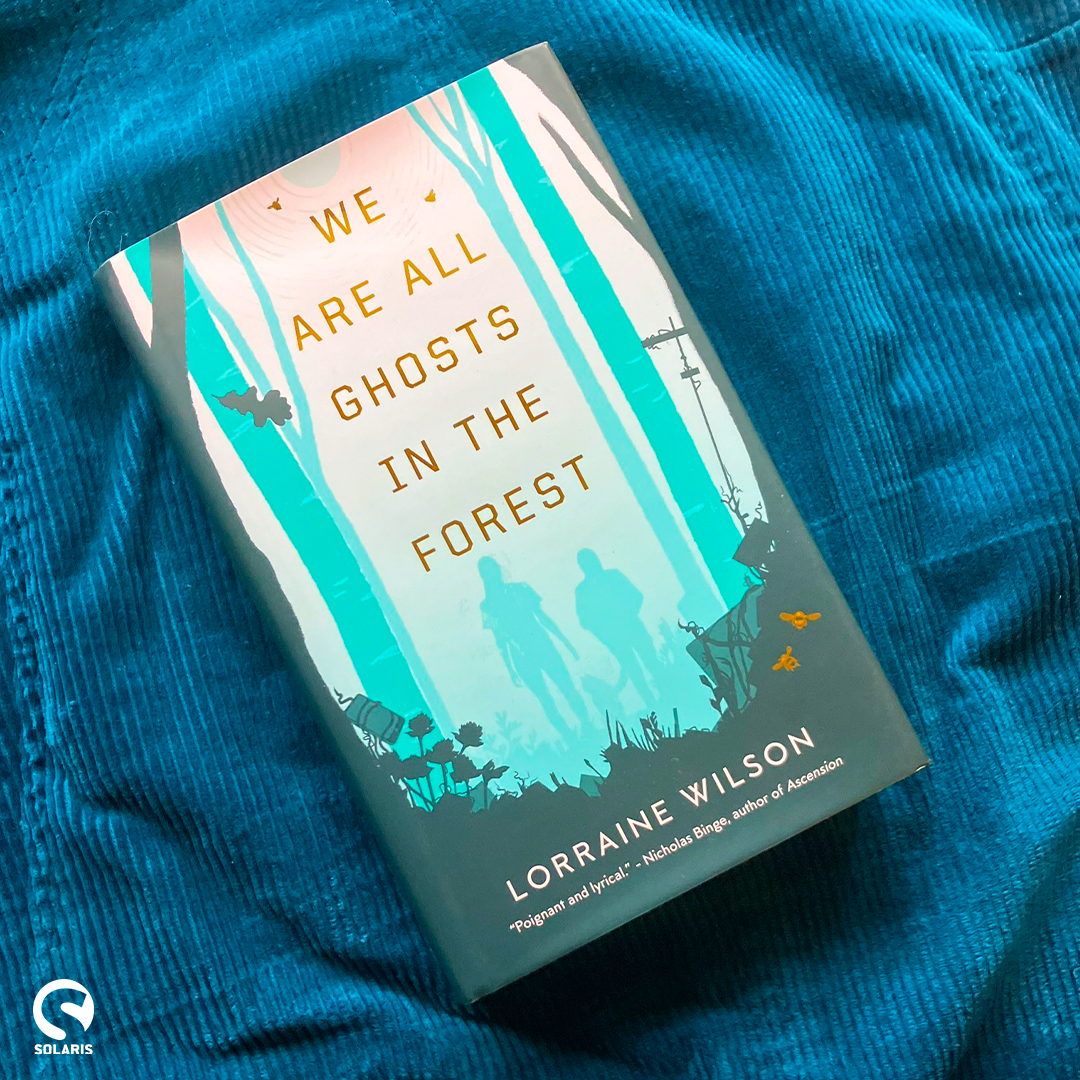
As you may have gathered from the last newsletter, The Salt Oracle is coming out in November this year, and is set in the same post-internet digital ghosts future as We Are All Ghosts In The Forest, but is another stand alone. Because of my appalling series staying power (or lack thereof) I am rather loving the rise of same world standalones at the moment and am delighted to have accidentally fallen in line with a kind-of trend. For the one and perhaps only time in my publishing life!
These Diary posts are usually a wee behind the scenes perk for my paying subscribers but I figure as this is by way of an introduction, I’ll keep this one public. As well as telling you a wee bit about the book and where it’s at, I thought it also might be interesting to talk about the developmental editing round I recently finished on this beasty. Because, let me tell you, it was tricky. And, well, difficult publishing things are generally useful publishing things to share, right? So strap in…
The book
This book is my take on Dark Academia, set on a floating college fortress in the Baltic Sea where her mentor’s murder thrusts a quiet researcher onto a path towards discovering the secrets behind the strange, deadly Oracle child that the college guards so carefully.
If We Are All Ghosts In The Forest was built on the folklore of forests, then The Salt Oracle is built on the folklore of the sea. It’s about our relationship with the sea, as much as it is my character’s relationship with the college she loves, and it’s full of darkness and terrible choices, and perhaps, just perhaps a whole lot of love too.
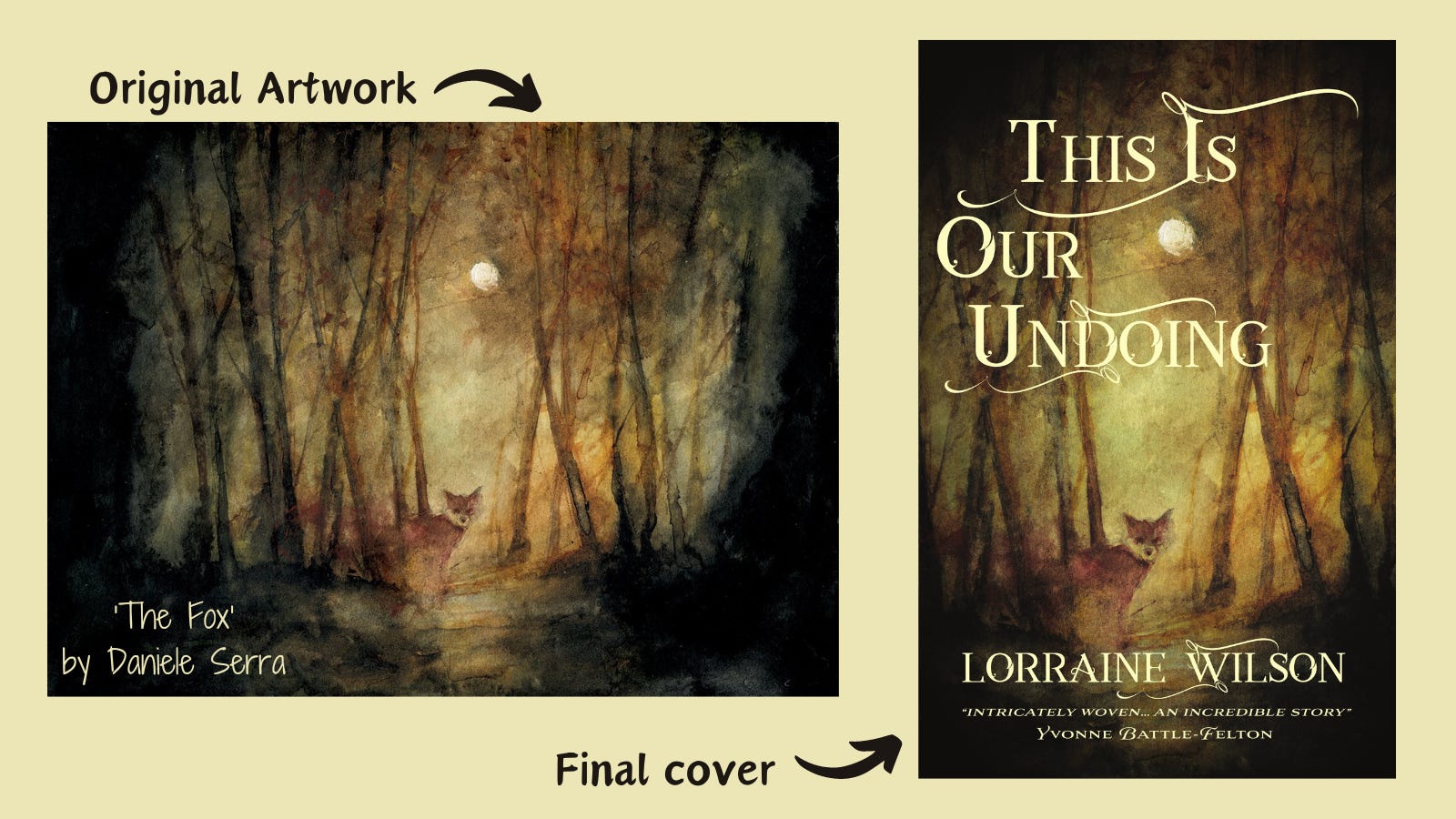
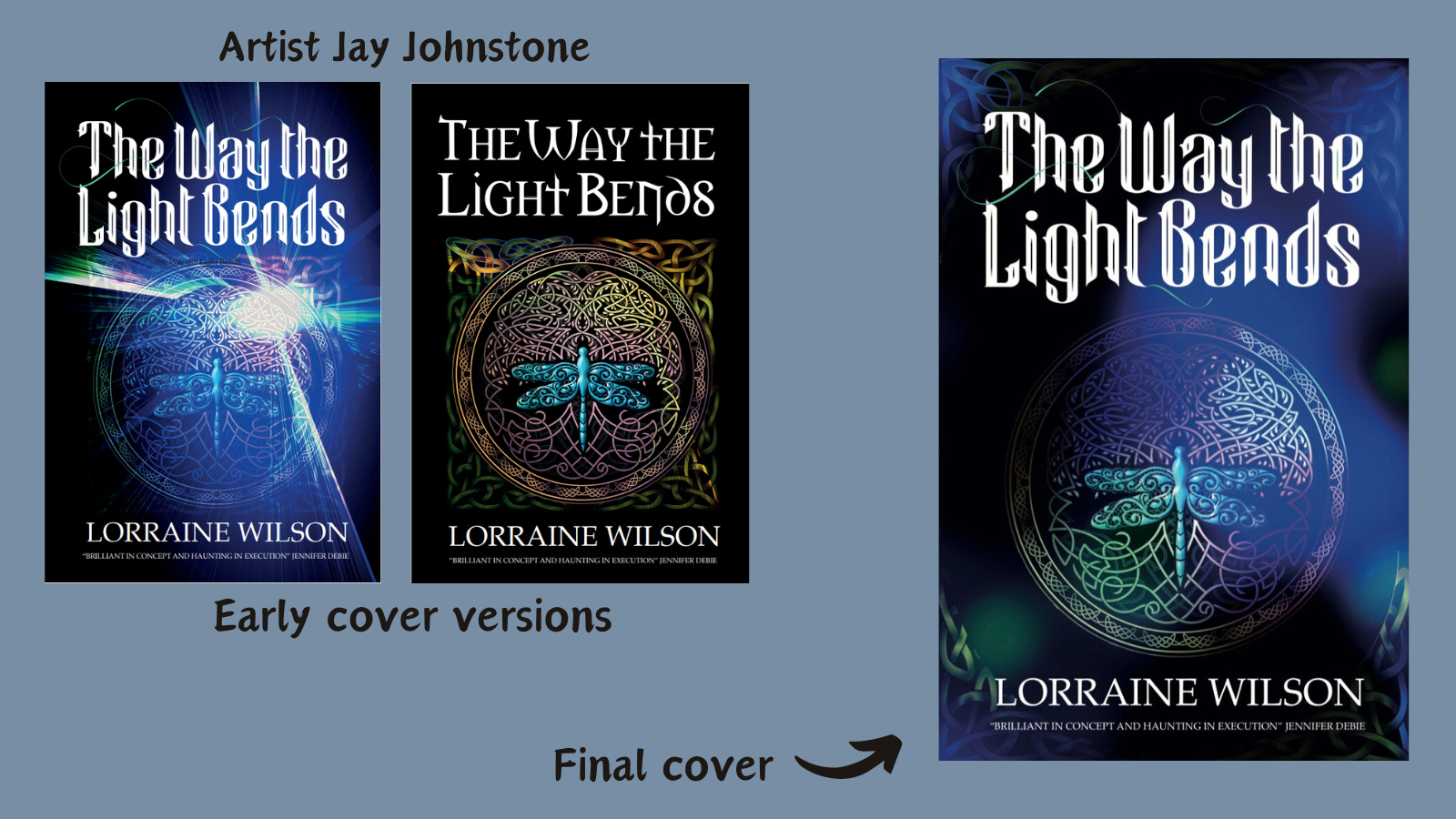
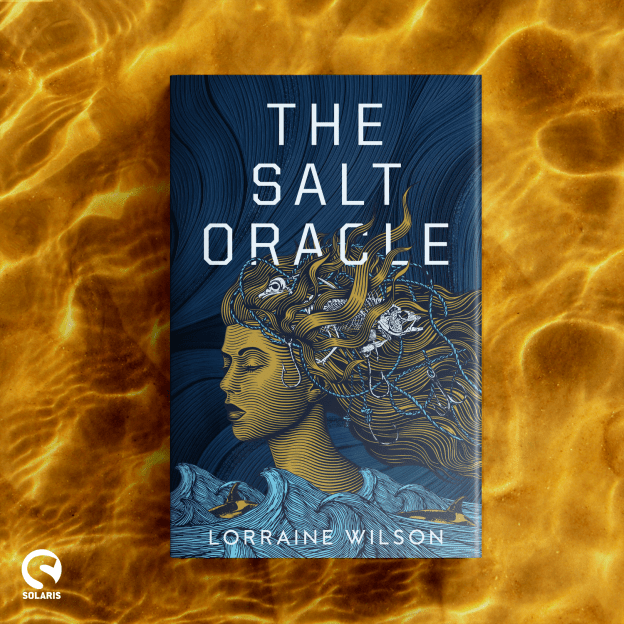
The cover for this book, as revealed in the last article, is to die for, and might in fact be my favourite book cover to date. Although let’s be honest, I have been really, really lucky with all my covers so far.

The Edit Letter
I’ve written before about dealing with the Edit Letter for We Are All Ghosts In The Forest (and Edit Letters in general), but to paraphrase, the Edit Letter is the foundation of editorial input on a manuscript from your editor (or agent, although those notes are often less formal). It tends to be a breakdown of big overarching issues, and then smaller more specific areas to address. Sometimes with a by-chapter breakdown and/or marked up manuscript.
My Ghosts edits were extremely light, but I knew Salt Oracle would be a different kettle of fish because it was significantly less polished when I sent it to my editor. That’s fairly normal for a contract book – you’re likely to be working to tighter deadlines and with less agent input before your editor sees it, so they are generally not scared off by a rougher second book.
But the edits I got for Salt Oracle were by some margin the most comprehensive edits I’ve yet received – 19 whole pages of overarching issues and by-chapter breakdown – and there were a few things in the mix there that meant they initially really knocked me for six:
- I came away from reading the Edit Letter convinced my editor hated the book.
- The edits were, for very valid reasons, later than anticipated so I felt very pressed for time.
- The edits asked for changes that would shift the feel of the book’s setting significantly, and I wasn’t convinced it would work.
- I was told I needed to cut my book’s length by over 20%. From 126k to 100k words.
Now, that first one can be put down to an over-sensitive author being over-sensitive. But it actually raised an interesting nuance to publishing that I think is worth talking about, hence its inclusion.
I got these edits just before Christmas 2024, and spent much of Christmas in a bit of a blue funk. I’m used to needing a few solid sulking days after getting an edit in, so at first this didn’t much bother me. I expected solutions to form in my mind, and the doubts and worries to morph into enthusiasm, because they had done before. But they didn’t.
I planned out my edits. The doubts and fears didn’t pass.
I started the edits. They still didn’t pass. In fact, if anything they were getting worse.
So around about New Year, I stopped and really looked at why I was reacting so negatively to the edits and what I could do about it. That, more than the details of the edit letter itself, is what I wanted to talk about here, as that’s what might prove useful to others if they too find themselves stuck.
Did my editor hate the book?
My editor had offered a call from the outset, but I usually prefer to just check in by email if I get stuck on anything particular and otherwise sort things out myself. Come early January, I realised I needed to talk some things through, and we jumped on a call. This call addressed a few things, but most importantly this first question.
And of course, no, she didn’t hate the book. She loved much about it, and the characters, the dilemmas and the messages of the book had struck home perfectly. Which was nice.
Something we talked about on the call though was the difference between an edit letter on an acquired book and an edit letter on a contract book. Because I realised that at what will be Book Six in my career, this was my first time with a contract book, and so my first time working with an editor on a book they hadn’t fallen in love with enough to fight for through acquisitions.
When an editor acquires your book, you know beyond doubt that they love it. So when they send an edit letter, you know it’s coming from a place of absolutely being on Team This Book.
Conversely when you have just yeeted a book at your editor that they maybe saw a rough pitch of over a year ago … you do not start with that same assurance.
It sounds a small detail. But when you are facing pages and pages of ‘this needs fixing’, not knowing whether there’s a preceeding ‘I love this but-’ matters. It’s hard processing pages of criticism, so you want to know whether the feeling behind them was ‘this is great, but let’s make it better’, or ‘ye gods why have I been cursed with this’.
This was, I think, a useful lesson for both of us in openness and taking the time to make sure we both know what the other is thinking. It made me incredibly grateful to have a relationship with my editor that makes these conversations easy and positive.
Time pressures
Again, on the call and follow up emails this was a source of anxiety that my editor was able to almost entirely remove.
We shifted the delivery deadline from mid-February to early March, with the knowledge that I could shift it further if need be without it impacting the publication date (which was my biggest worry). Shifting too much further would start to impact our ability to get ARCs out to reviewers though, as well, frankly, as bleeding into time I’d scheduled for other projects. So I didn’t want the deadline to slide too much. But it was very reassuring to know I wasn’t at risk of losing my late 2025 publishing slot.
Edits that don’t feel ‘right’
There were two overarching ‘structure’ changes my editor requested. One was to cut out the wider state-level politics to keep the threats surrounding the College more direct and tangible. The other was to cut the number of characters by some way, as it currently felt too confusing with many of them mentioned too briefly to stick in the mind.
The state-level politics was a fairly easy fix, although the College still needed external connections, otherwise how was it funded? So I’ve not been able to cut all ties to the wider world, and instead have replaced state politics with the politics of appeasing multiple contractors and a university main office. At the outset therfore, I wasn’t sure this background change would really improve the book materially.
The character cull was trickier. I had intended the College to feel like a busy, multifaceted research organisation, full of disparate teams all with their internecine rivalries and my main character isolated within it all. Cutting a lot of characters would fundamentally shift the nature of the College from busy academic institution to small research outpost. More of a remote field station than a center of learning. That’s quite the vibe change, and I wasn’t sure I liked it – I felt it was important that the College look successful For Reasons.
But my approach to edits I’m unsure of is generally to try them and then decide, so that’s what I did. After making sure I had back up copies of the book!
Now it’s done, I think shifting the College’s management structure from political to contractual has simplified and tightened things in a way that works nicely. The move from busy to small I also think now works well – I have leaned into the idea of the College being half-empty due to the umm… attrition rate (!), and the echoing spaces and survivorship atmosphere add some vibes to the book that I wasn’t initially looking for but that I think are pretty cool. And yes, it’s easier to keep track of the characters now too. So although at first I was really hesitant about these edits, guess what? My editor was right? Curses.

Cutting word counts
Perhaps, now I’m out the other end of this edit, this was the trickiest issue of them all. You see, although a good amount of tightening and cleaning up of the prose was definitely needed, the main driver behind the 20% wordcount cut was actually the high price of paper and printing at the moment.
It is, it turns out, one thing to make any number of edits that are intended to make your book better. It’s a whole other thing to make edits to your book that are primarily about making it cheaper. I worried that in cutting words which didn’t strictly need it, I was stripping my book of some of its nuance, its subtlety, its beauty. And as I wrote about recently, I like that stuff! So that editing pass felt rather soulless, if I’m honest, which was a shock – editing is something I generally enjoy and that gets me excited about the book.
I absolutely understand the requirement. Publishing margins for independent presses are under very real pressure from printing costs alongside other factors. So I don’t resent the expectation, although I will endeavour not to be in this position in future (by having those conversations at the contract stage, I imagine, so I’m not caught unawares).
Fortunately having read the shorter version, it does still have nuance and subtlety and beauty. The book’s themes still feel vibrant and strong, perhaps more so for the (relatively) pared back prose matching the vibes. Plus, the cuts have helped me sort out several plot tangles and hone the pacing. It is still, vitally, the book I wanted to write and a story I am very proud of. Honestly, being forced to cut so much whilst not losing the feel of the book has probably been a useful experience for someone like me, who does love a long sentence.
But where I was able to put to rest all my other worries about this book and its edits, this one remained. It wasn’t until I got comments and line edits back from my editor last week that I knew I’d nailed the challenge – my editor was delighted and my line edits took me less than two days. *cue celebratory dancing*
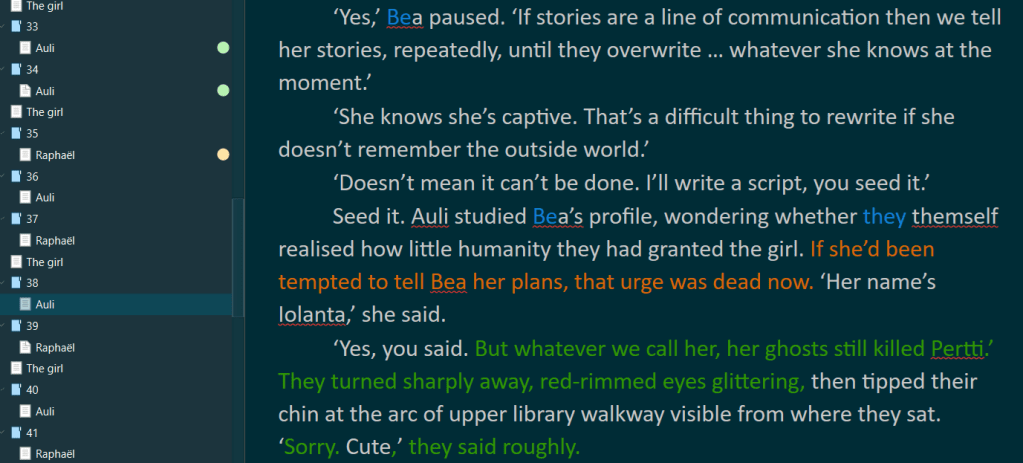
An in-progress editing screenshot from Scrivener showing three different edit passes as different coloured text. This let me keep track of what I had changed & why.
The actual editing process
Just a quick note here, in case anyone is wondering how I went about such a big edit. The answer is I broke it up into five separate edit passes dealing with different things each time. I dealt with all the actual editorial changes on the first three passes, then did a Big Cut pass where I focused purely on cutting words, then finally did a kindle read-through to catch errors, smooth out over-edited bits, and generally reassure myself that it still worked and I still liked it.
It does and I do. Fortunately.
So, there it is, the next book in all its complicated glory. I love it, and I hope you will too when it reaches you. But man, this one has put me through my paces. It’s been a valuable learning curve though – both in terms of my process, and in being able to continue loving a book through all its permutations.
Thank you for reading and I wish you all a relaxing weekend.