Tag Archives: Books

Holiday book recommendations – gifts, reading and feeding the tbr pile

Happy omg there’s only two weeks to Christmas to all who celebrate!

Those of you who’ve been with me for a while will know I don’t like doing ‘Best of’ or ‘Top reads’ type lists because they’re so subjective and I don’t really want to rank my favs from my friends, heroines and peers. What I do like doing every year though, is a ‘if you’re looking for X kind of read, how about trying this?’ list fuelled by things I’ve read in the last year. Yes, I might be splitting hairs with that definition and no, it’s not that catchy. But it soothes my wariness of best ofs whilst still letting me celebrate some fabulous books.

I read somewhere in the region of 120-150 books this year, and considering I only count books I enjoyed enough to finish, that means I simply can’t list here all the books I loved this year. Which stings, and I’ve spent possibly more time than I should scowling at my Kobo while I try to rationalise including so many! (I have included so many, I apologise. Kind of)

BUT, that said, behold a host of gorgeous books – some new releases, some older – divided according to vibes with no regard at all for genre label because pfft – genres shmanres.


Deep, beautiful and/or heartbreaking

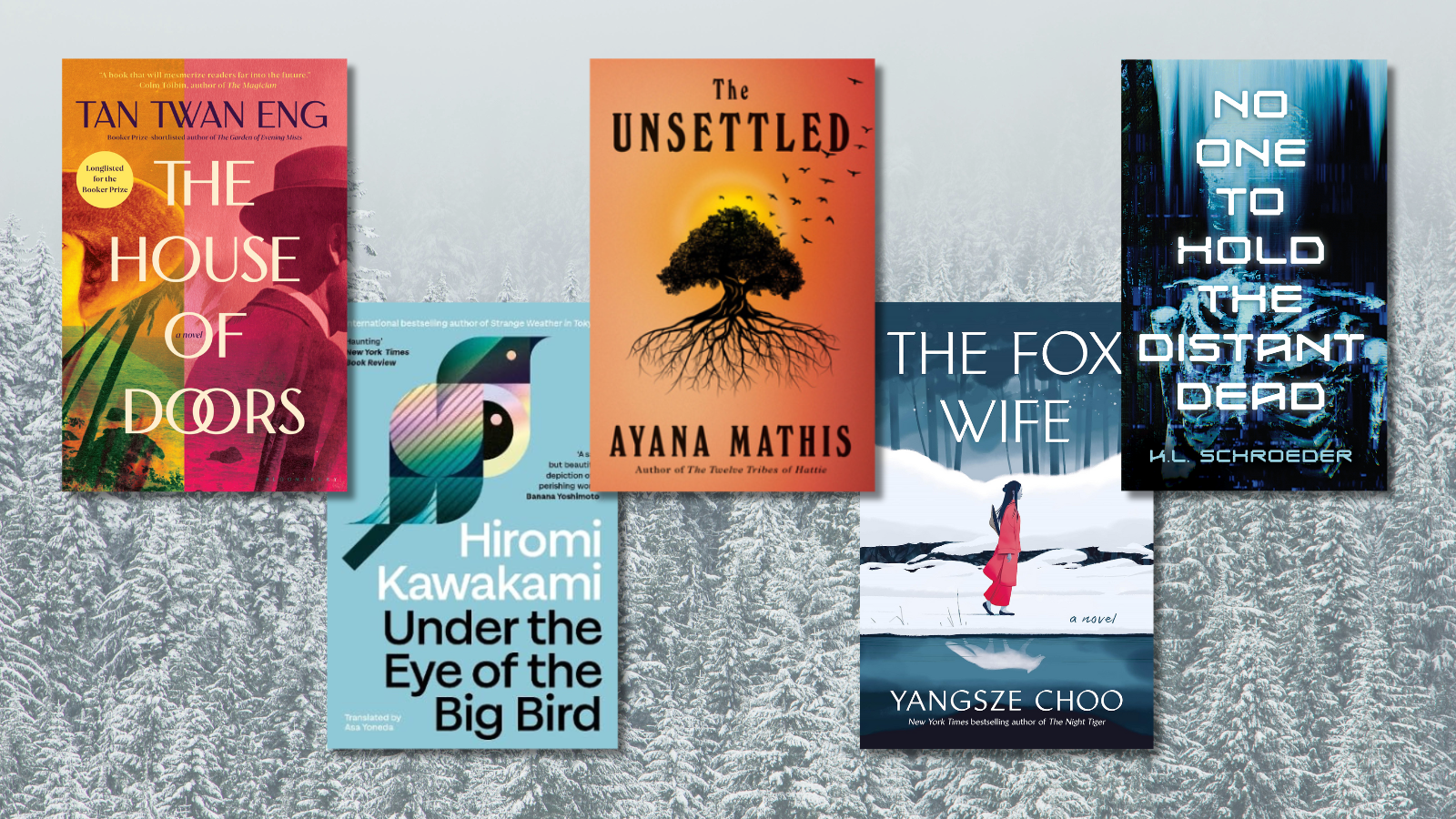
The House Of Doors – Tan Twan Eng

I don’t know what to tell you. Tan Twan Eng writes too beautifully to be quite human. There’s a gentleness to this historic, continent spanning, speculative love story that makes the emotional punches hit all the harder. I could read him forever.

Under The Eye Of The Big Bird – Hiromi Kawakami

The understated, sparse prose of this novel serves the searing emotional core to this book really well, in my opinion. It’s a subtle mystery set in a far future, oddly evolved version of humanity and almost-humanity that feels original and deeply thought provoking without attempting to wrap difficult questions up with neat answers.

The Unsettled – Ayana Mathis

A hard read, in some ways, but deeply compellling. Following a mother and child, this is a powerful exploration of poverty and societally vulnerable familes, and the profound, complicated ties that run through generations.

The Fox Wife – Yangtsze Choo

Someone else I could read forever. Choo’s deft, gentle story of a woman coming to terms with her own past, and figuring out her future, is beautifully handled and hypnotic. This is the fox-changeling story you didn’t know you needed.

No One To Hold The Distant Dead – KL Schroeder

Perhaps the last novella release from the indie press Psychopomp, this is a devastating story full of eco-grief and rage in equal measure, with perhaps a dash of comfort and hope. If you have ever wanted to scream at the godawfulness of the extinction crisis, you should probably read this book.

Step into the past (kind of) & lose yourself

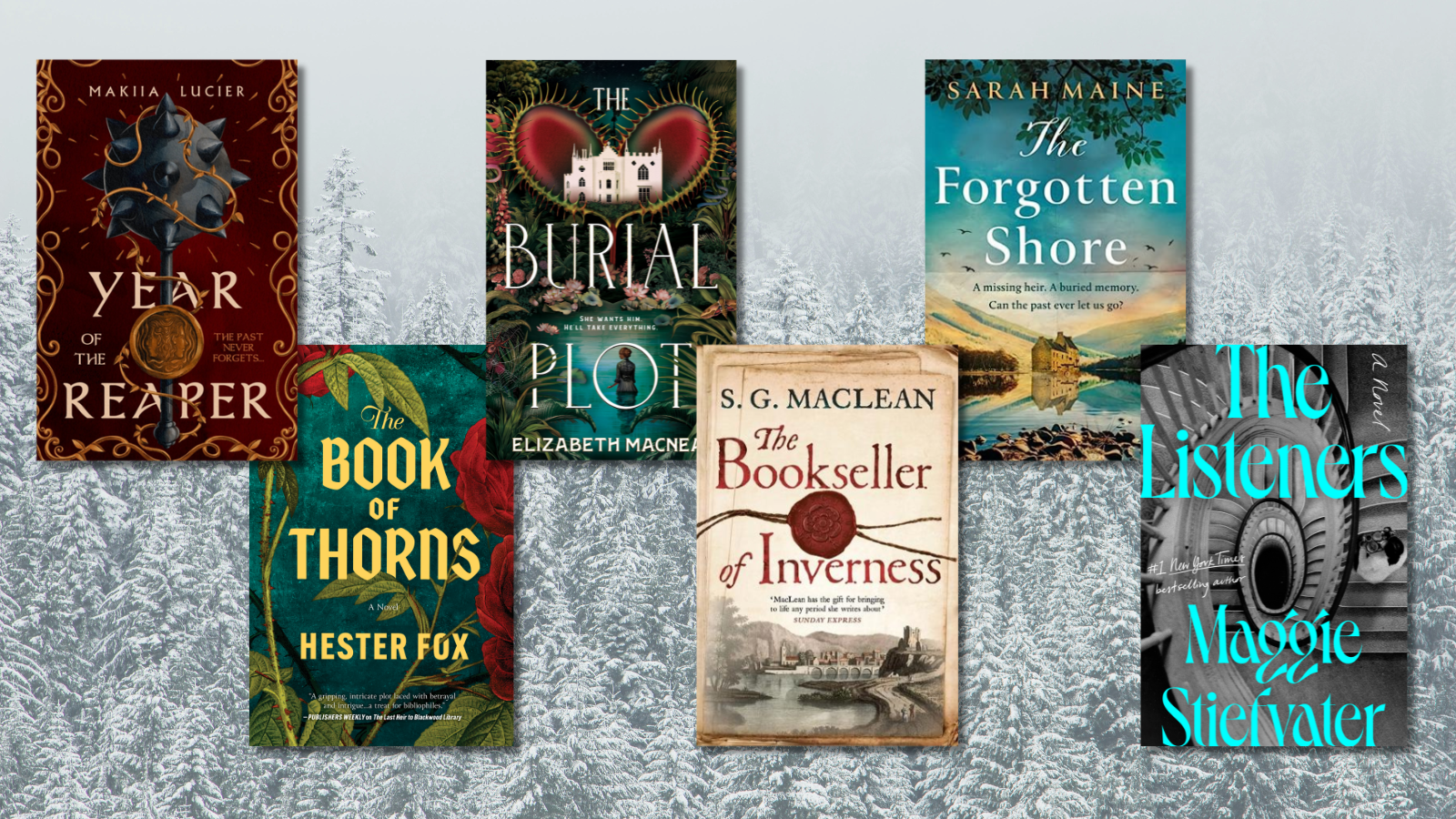
Year Of The Reaper – Makiia Lucia

A book to dive into, this is alt-European historical fiction with a fantastical twist, that combines plague, politics, family secrets, romance and ghosts in perfect balance. It’s a pacy and riveting read that asks some really good questions about loyalty and compassion.

The Book Of Thorns – Hester Fox

Fox always offers up a really engaging, enjoyable read and this book, following separated sisters on opposite sides of the Napoleonic wars, is no exception. I love the way she beds a light fantastical touch into her worlds so convincingly.

The Burial Plot – Elizabeth Macneal

Straight history but with definite Gothic tones to it, this book has a ‘bad guy’ you’ll want to punt out the nearest window, but the relationships unfold in exactly the right way and the odd premise (let’s build a graveyard!) makes for a fun difference from similar books.

The Bookseller Of Inverness – SG MacLean

My first MacLean book but I’ve since hunted out and inhaled a couple of others – she’s even got me started on a long series (the Seeker books), which is something generally anathema to my fried brain. I am a sucker for a bit of Jacobite historical fiction, and this was a fresh, beautiful and captivating addition to that space, exploring the quiet power of women in a way I really liked.

The Forgotten Shore – Sarah Maine

Maine knows how to write yearning on shorelines really, really damn well. I love every one of her books, and this is perhaps my new fav from her. A romance tangled up in family secrets, tragedy, and a profound sense of place in both Scotland and Newfoundland.

The Listeners – Maggie Stiefvater

Set in a hotel housing political prisoners as the US prepared to join WWII, Stievfater’s adult debut has all the gorgeous worldbuilding of her YA novels (hello The Scorpio Races, I love you), characters who get under your skin, and a bright, brave heart.

Near futures (to avoid)

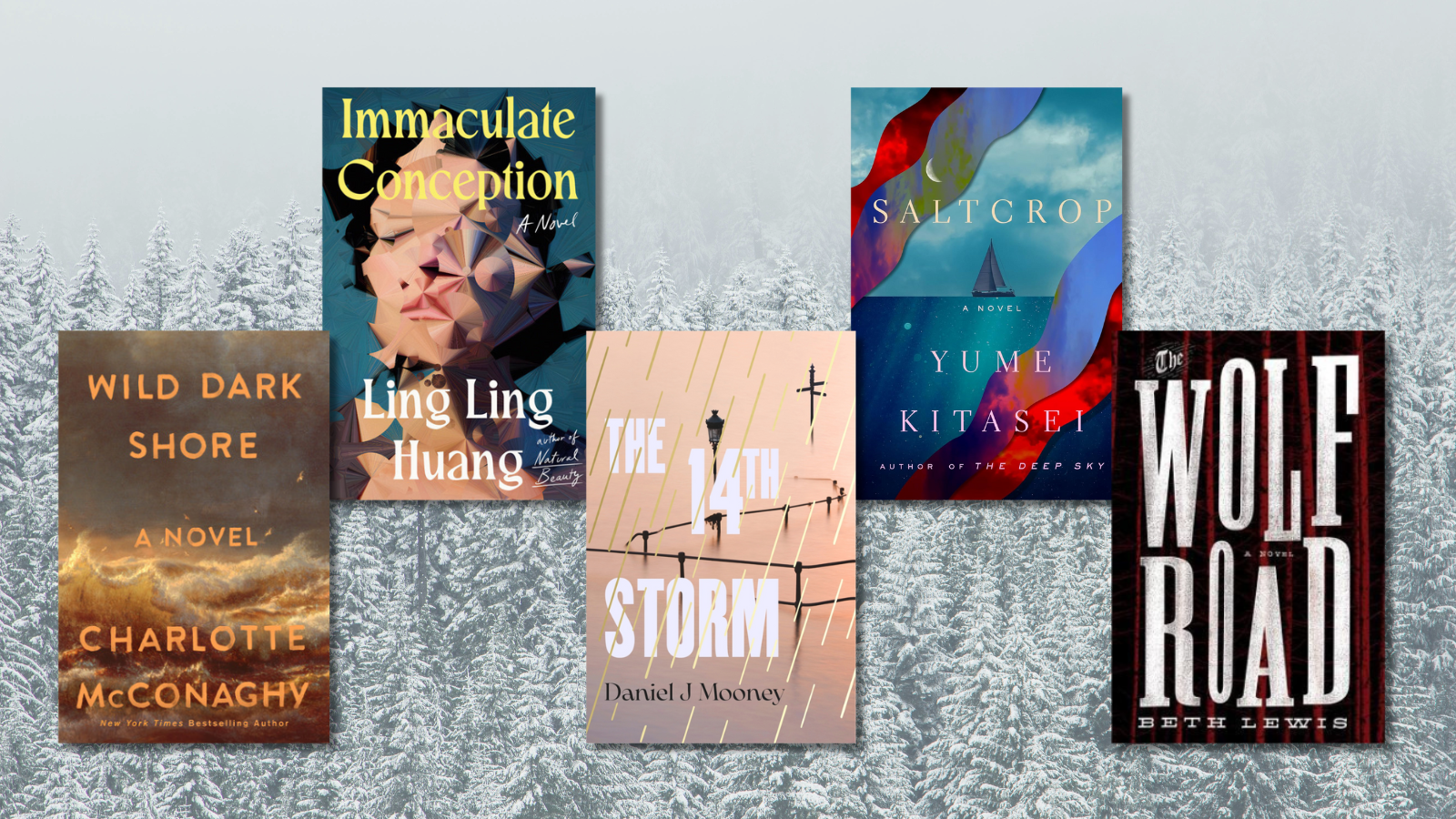
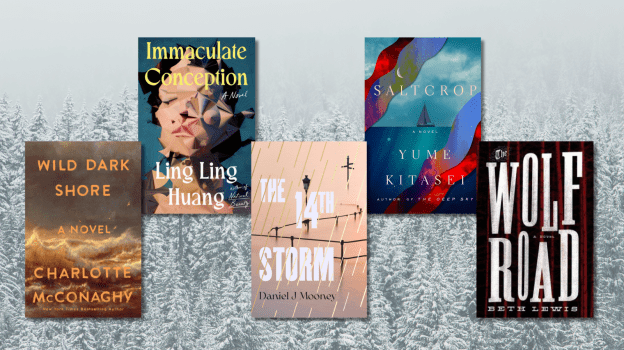
Wild Dark Shore – Charlotte McConaghy

This book seems to have landed really well with a wide readership this year, not surprisingly – it has all the requirements of a thriller in a remote, isolated place, layered with secrets and the ticking clock of the flooding seed bank the characters are protecting. The climate change setting is backdrop rather than theme, but it definitely adds to the heartbreak and tension.

Immaculate Conception – Ling Ling Huang

I went into this book entirely blind and and am kind of glad I did. It was a startling exploration of the meaning of art, and of a deeply unhealthy friendship, doing interesting things with voice and ideas of ownership, culpability and consequence. I immediately added Natural Beauty to my tbr.

The 14th Storm – Daniel J Mooney

A sort of climate fiction thriller, I love the setting of this book – a future Ireland reshaped by climate change – and the core set of characters who just grab hold of you and drag you along for the ride. A lot of fun, and some pertinent questions about political messaging and power to boot.

Saltcrop – Yume Kitasei

A road trip book for the rising seas. This is a strangely gentle, urgent book about sisters navigating an altered world and their own complicated pasts. The mystery plotline weaves nicely into the more thoughtful side of the writing, and it’s made me add Kitasei’s previous books to my tbr.

The Wolf Road – Beth Lewis

What a bloody, gnarly delight this book is. Any world where the moment of apocalypse becomes known as the Damn Stupid has got to be a winner, hasn’t it? But this book is a wild, dark, unique gem of a thing. Wild west post-apocalyptic deadly hide and seek across a desperate and strange land, with a young girl forced to unravel her past and her relationship with a dangerous man.

Dark, tangled and gothic

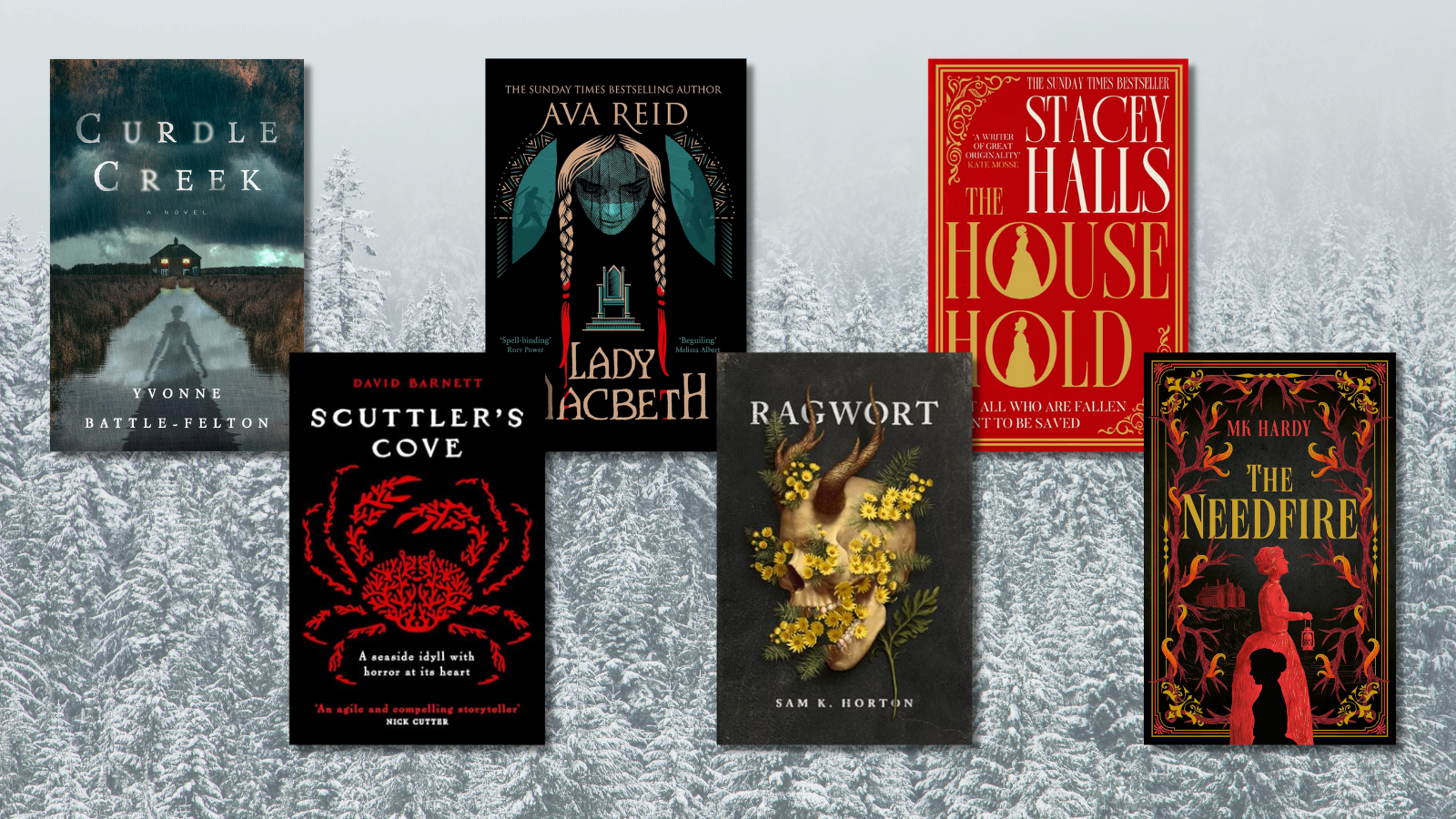
Curdle Creek – Yvonne Battle-Felton

Yvonne’s first book, Remembered, blew me away with its beauty and power, and Curdle Creek did exactly the same for very different reasons. The dissonant voice of the main character is a brave and brilliant choice that underpins all the sinister horror of the setting. This is a twist on small town horror like you’ve never read before.

Scuttler’s Cove – David Barnett

Another small town horror, but in a much more familiar-to-me vein – the Cornish village bound to the sea through dark ritual and secrets, the incomers stirring up trouble… Yes, it’s a familiar story, but man, Barnett tells it so well. Deliciously tangled and alive, this is the kind of folk horror I adore.

Lady Macbeth – Ava Reid

A Macbeth retelling that genuinely isn’t doing the same thing as the others – the witches are remade brilliantly, and a crucial character also happens to be a dragon! I really enjoyed this as a wild and original, and properly bloody, romp through the grounds of the scottish play and the history behind it.

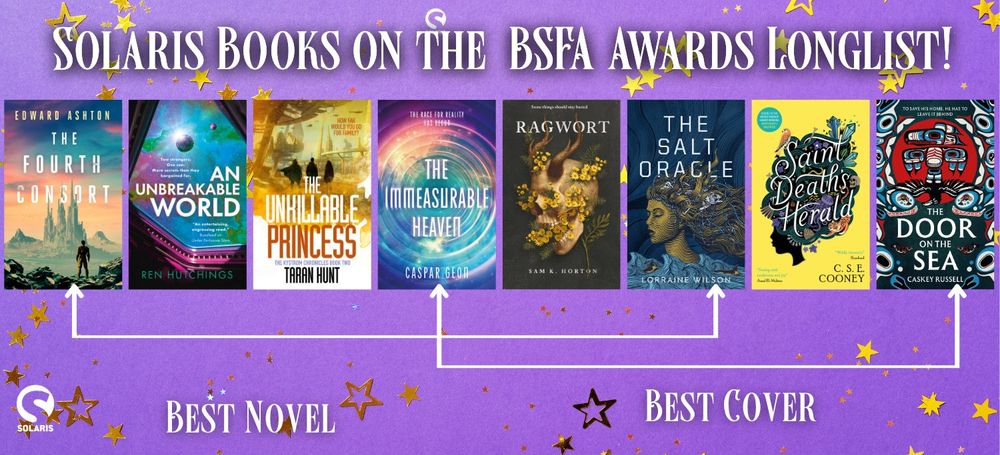
Ragwort – Sam K Horton

This is the sequel to Horton’s debut – Gorse – and follows the young Keeper, Nancy, after the death of her mentor at the end of the previous book. It is a stunningly told story of Cornish folklore twisted into something fresh and timeless, of coming into your own powers and learning your own skin. This is a book to savour.

The Household – Stacey Halls

Halls can always be counted on for a captivating Gothic read, and I feel that this one leans even further than her previous into exploring female relationships, alongside how women of the era must contort themselves to claim agency over their own lives. Based on a fragment of Dicken’s life, but fortunately not really to do with him at all!

The Needfire – MK Hardy

Set in the far north of Scotland in the aftermath of the Clearances, this is Gothic horror with a folkloric edge, and run through with a beautiful, hard won romance. Taking the requisitive brooding old house on a cliff, a silent laird, and local secrets, this story is far more than those dark bones – exploring environmentalism, sexuality, and quiet power with a deft touch.

Magical, fun and sometimes swoony

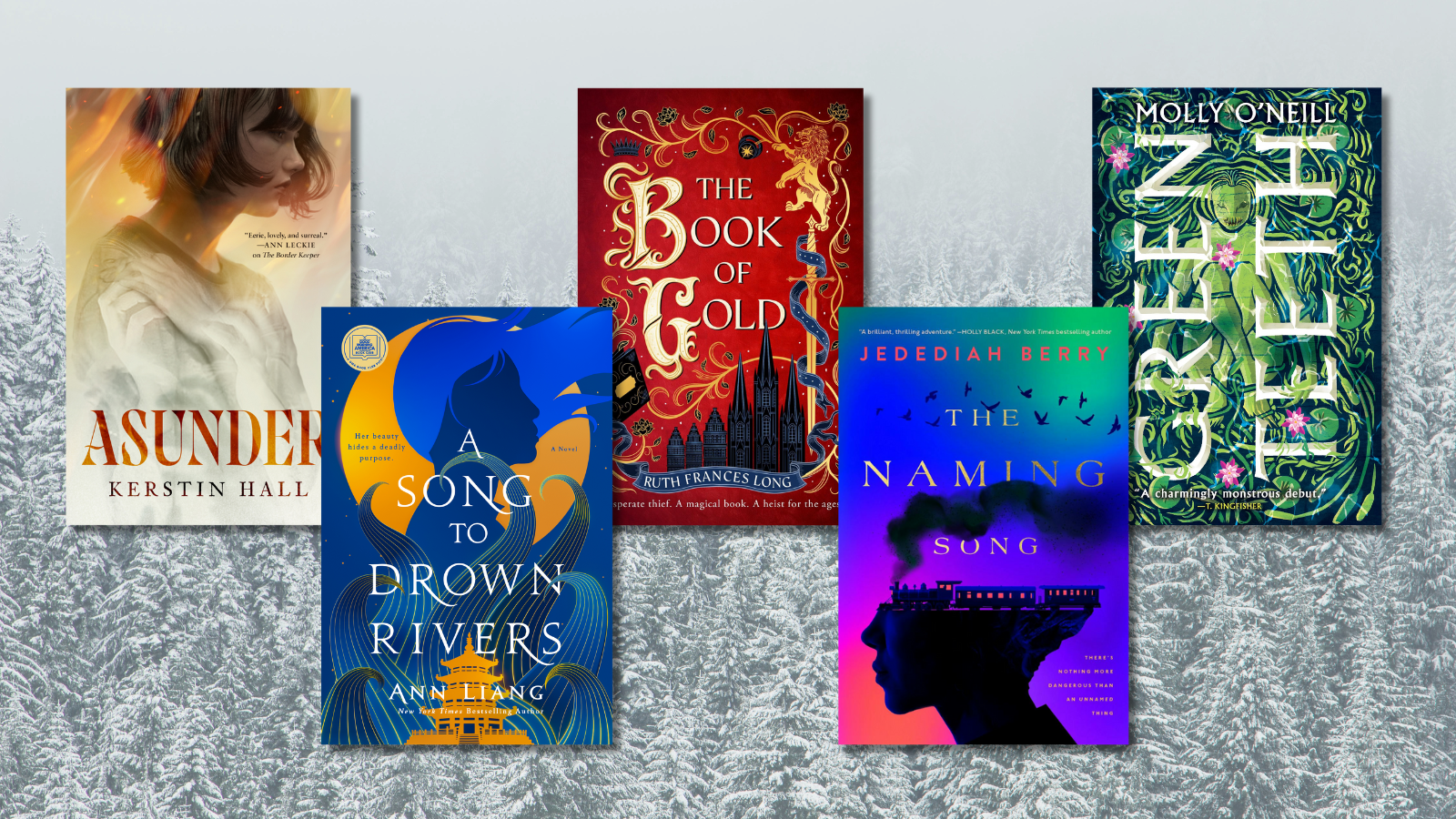
Asunder – Kirsten Hall

A really clever fantasy playing with ideas of gods, debts, and power in a way that feels original and just a little bit challenging. The romance, between the main character and, basically, a voice in her head, is brilliantly done. It shouldn’t work, and yet… I really hope book2 gets its chance at life, because I Need.

The Book Of Gold – Ruth Frances Long

If you want a breathlessly fun ride through an alt-history fantasy jam full of heists, flawed siblings, complicated romance, court politics, evil shenanigans, and fickle gods… well, this might be for you. A whole lot of fun. If you loved The Raven Scholar by Antonia Hodgson (I did, I really did, why isn’t it on this list??) then give this a go.

A Song To Drown Rivers – Ann Liang

I am still a little broken by the end of this book and if I ever meet Liang, I intend to Have Words. It’s a devastating story of court politics, betrayals and power, inspired by the Ancient Chinese legendary beauty Xishi. Enthrallingly told and… no, I am too broken. Read it, join me in the sads.

The Naming Song – Jedediah Berry

I do love a train book. And this is a spectacularly original train book – in a world where the names of everything have been lost, a train crosses the landscape, rediscovering words and bringing them to the populace. The concept alone is wonderful, the plot of secrets, rebellion, murders and family makes the whole an absolute joy.

Greenteeth – Molly O’Neill

This book had been sitting in my tbr for a while, but oh what a treat once I finally got to it. I love the Jenny Greenteeth folkloric figure anyway, but what O’Neill has done with her is wonderful, rendering her simultaneously incredibly inhuman and yet utterly relatable. Aside from the plot, delightfully full of traditional mythological way points and motifs, Jenny’s personal journey is tender and heartwarming to follow.

Dramatic, dangerous and innovative

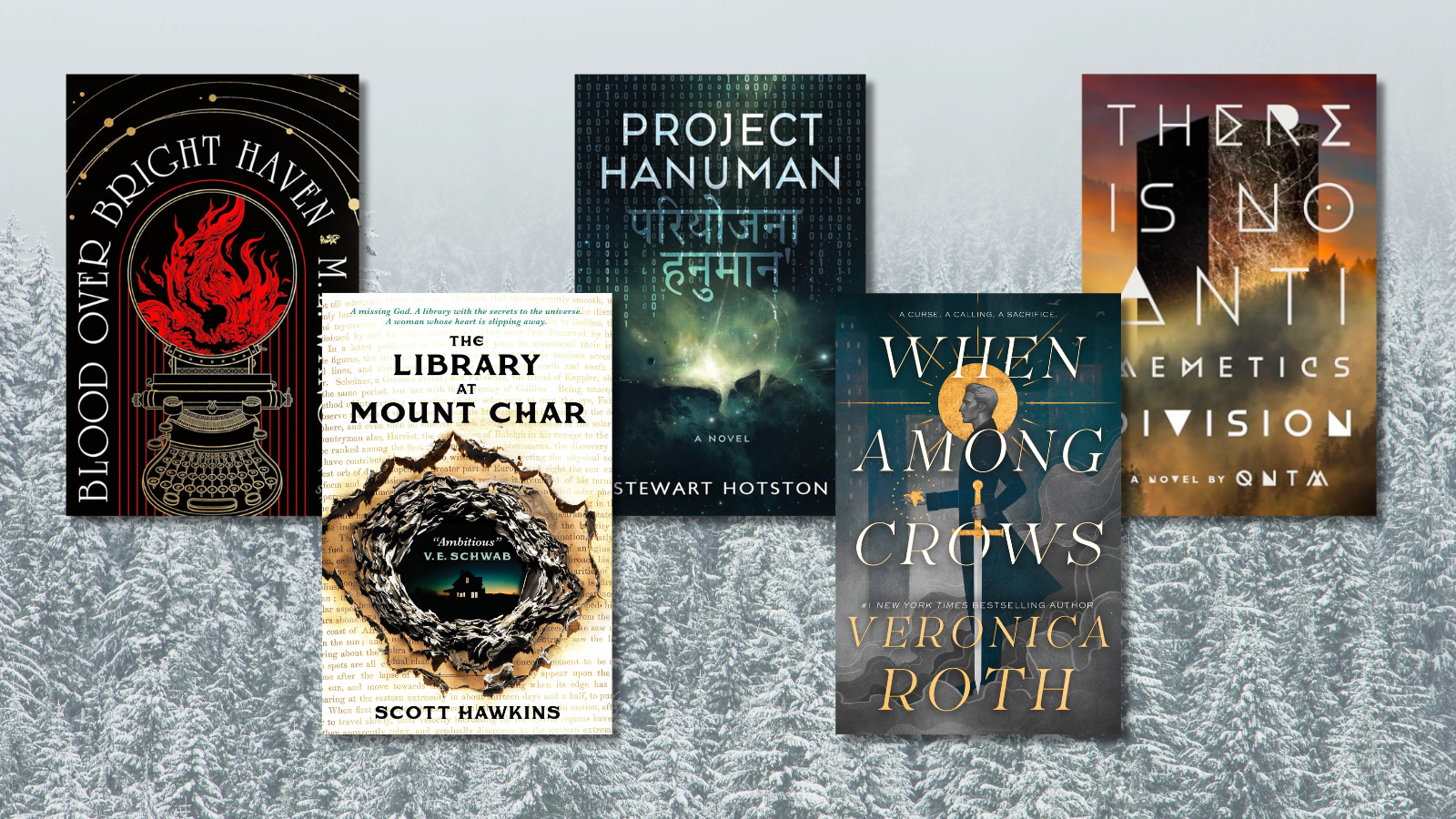
Blood Over Bright Haven – ML Wang

This is a darker fantastical tale that poses some really interesting, and pertinent, questions about xenophobia, immigration, colonial violence, and the complicity of educational institutions in that violence. Whether you agree with Wang’s answers is less important than that you have a splendid time with this riveting story, and feel something strongly about the ending.

The Library At Mount Char – Scott Hawkins

This book felt like The Umbrella Academy for grown ups. It’s not really about the eponymous library so much as it’s about the terrible, twisted bonds between the children raised within it, and the path they all are forced down by the machinations of their surrogate father. Dark and kinda devastating, this was much more than I was expecting, and I am so glad.

Project Hanuman – Stewart Hotston

This is what space opera is meant to be. A searingly clever, thoughtful adventure through space, quantum physics and virtual realities, where the aliens, the sentient warships and the higher intelligences are all bedded in a deeply interesting exploration of identity and our understanding of ourselves.

When Among Crows – Veronica Roth

I am a sucker for some Polish folklore, and this twist on that, set in the US, was every bit as delicious as I’d hoped. I love Roth’s ability to expose new, potent sides to familiar archetypes, and she did that here with figures that felt deeply folkloric but also tragically, horribly human.

There Is No Antimemetics Division – qntm

I confess I am in the middle of reading this one, but it’s such a brain meltingly ingenious book I’m sneaking it in anyway. The concept – of antimemetic objects which erase knowledge, personhood and matter – is a great starting point; building a story around not remembering plot-relevant things is a bold undertaking you just kind of have to admire! It’s a fascinating read that I’ve reluctantly set aside for some overdue ARC reading…

Look out for…

The Republic Of Memory – Mahmud el Sayed

As with Project Hanuman, I think this book is going to bring some brilliant fresh oxygen into space-based SF next year. El Sayed had me signed up at ‘Arabfuturism’ but add in generation ships, popular uprisings, and failing powers, and I am so excited to have my ARC of this queued up.

Princeweaver – Elian J Morgan

My current read is this beautiful reimagining of Welsh folkoric history, that imbues a tale of court politics, banned magic, and rebellion with a deep love of Wales. Add in a beautifully told romance, and you just know how much fun I am having right now.


OMG that was so many books to remember, and summarise without repeating superlatives too many times! I have cooked my brain, but I sincerely hope some of these titles will find their way onto your present buying lists. Or perhaps into your xmas present book token boxing day shopping cart.

Please do let me know your fav reads of the year?

Thank you as always for your support. Because accessibility in publishing is important to me, I keep all my craft and publishing posts free, so any shares or tips are greatly appreciated. Wishing you a fabulous weekend.
check out my books here

leave a tip here

Book launches – survival, celebration and chocolate

Hello fellow creatures. I usually write a ‘the story behind the book’ post around publication day, but I feel like I’ve chatted a lot about The Salt Oracle over the last year either here or on my mothballed Substack, both in free and in paid posts. So what else around book publication time might be interesting to you, my splendid readers?

How about the odd emotional complexity of book release?

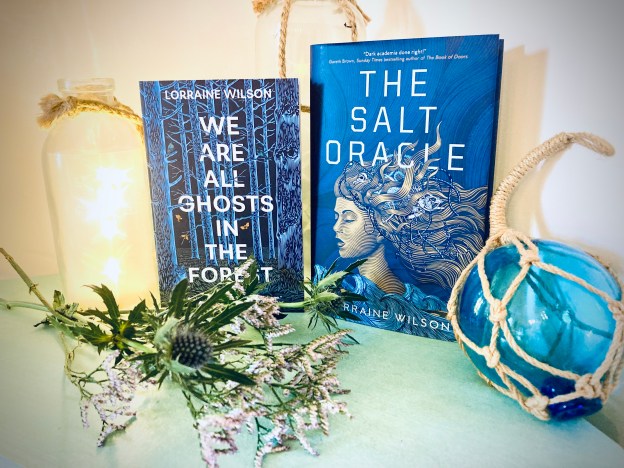
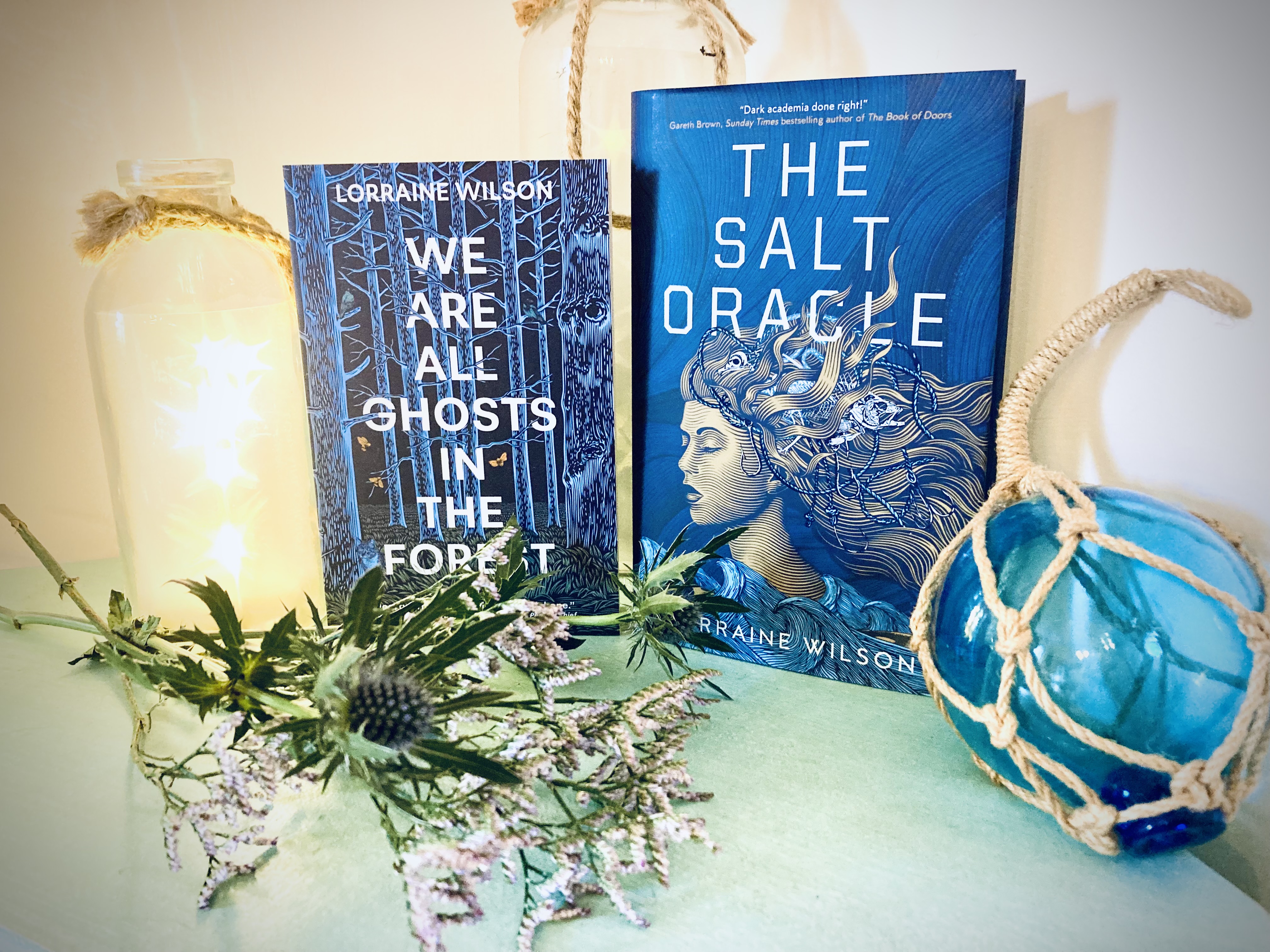
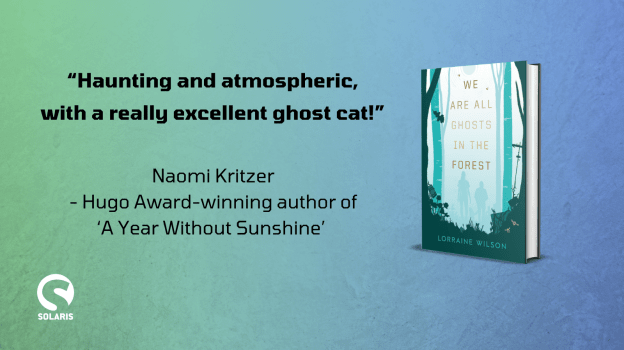
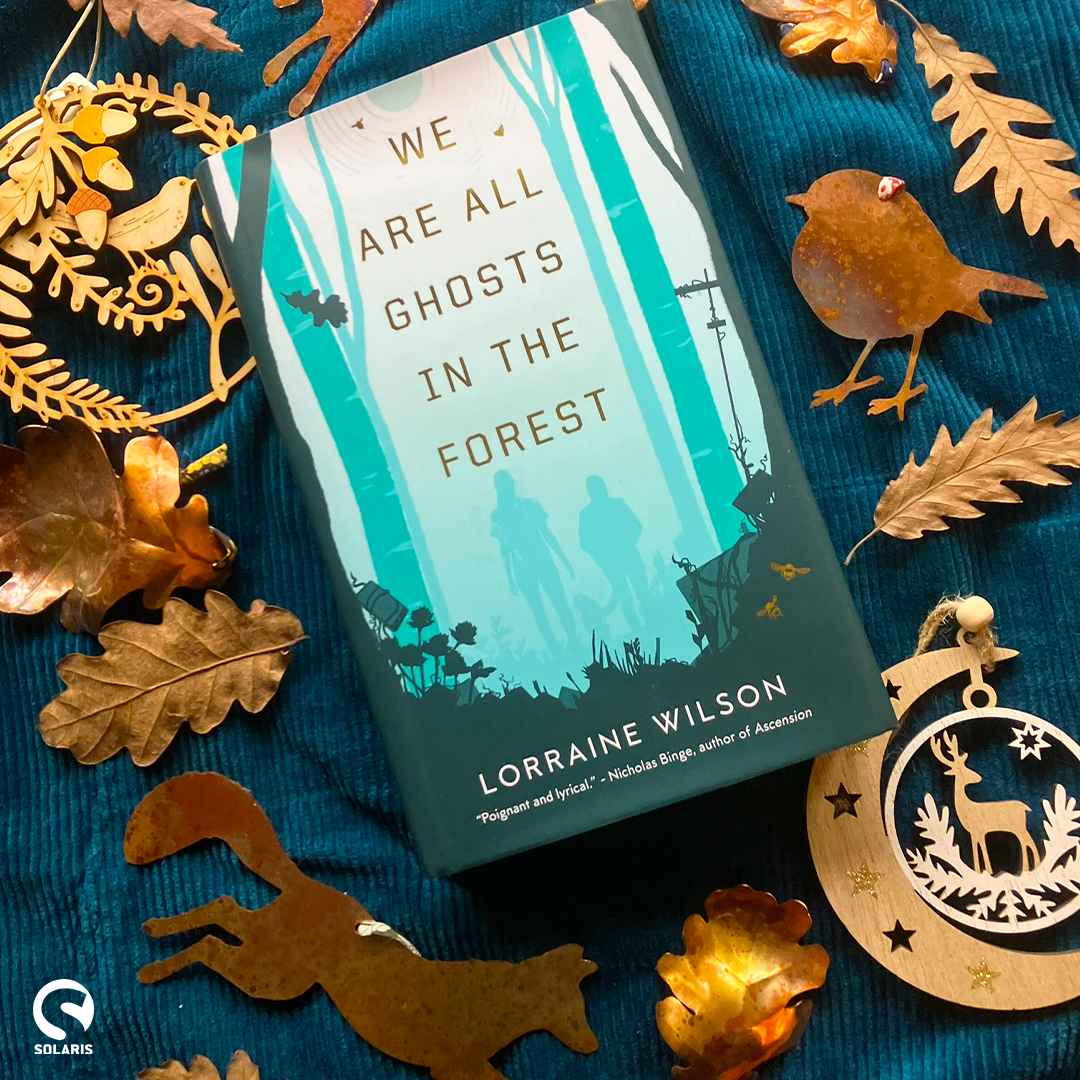
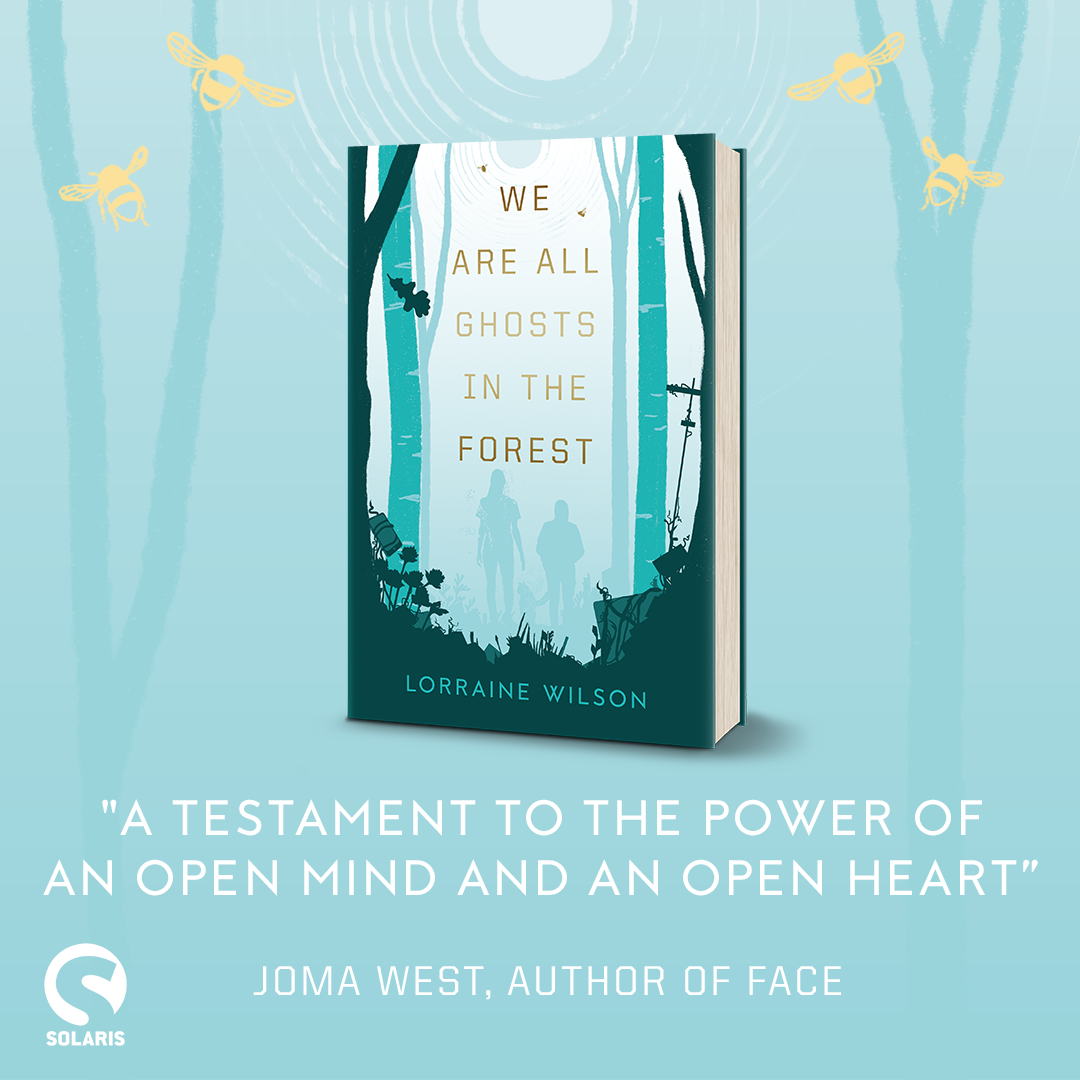
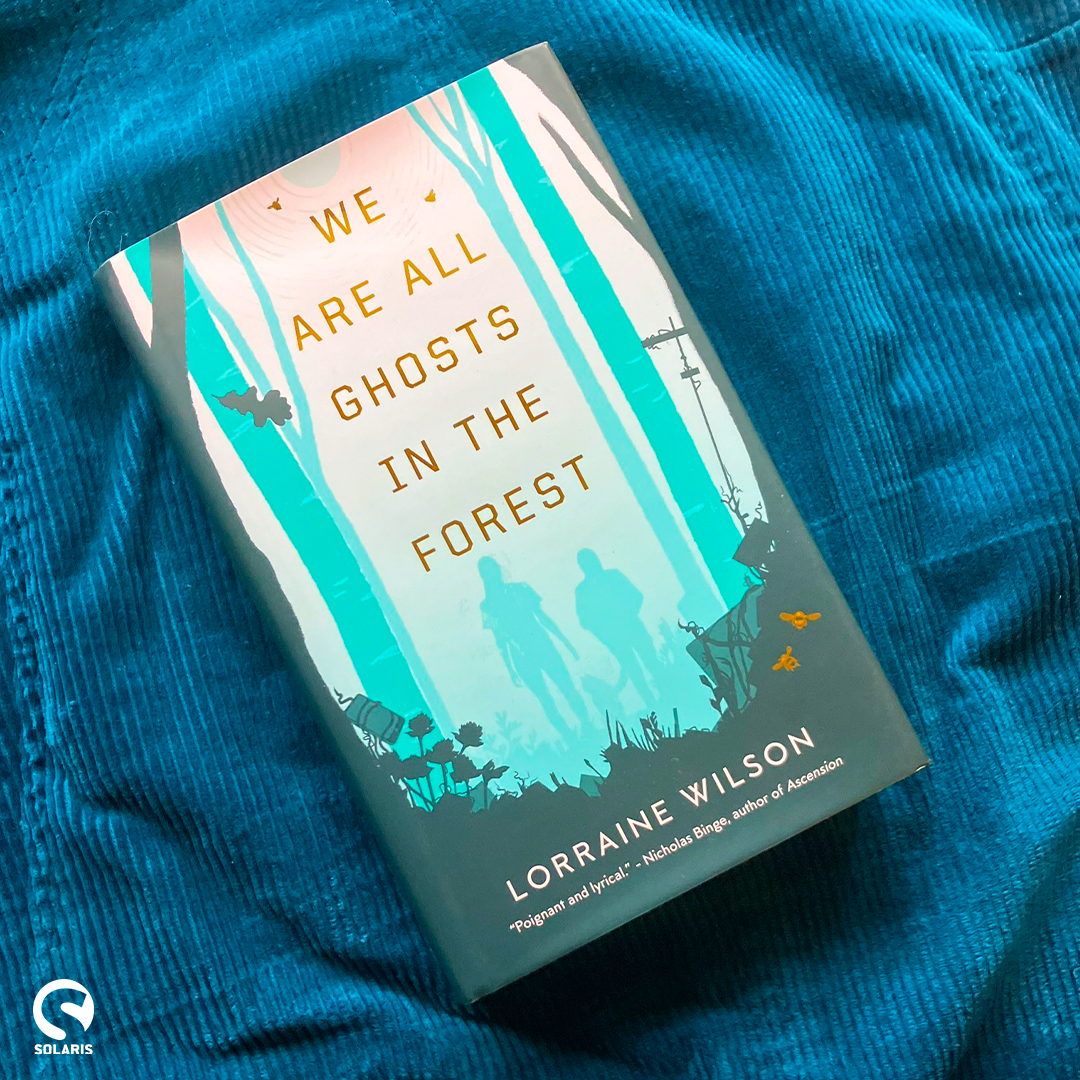
Last Thursday, We Are All Ghosts In The Forest was released in paperback, and The Salt Oracle was released in hardback/ebook/audio. Which is Lovely and An Achievement! Publication day is generally seen as an unconditionally joyous moment. In my experience though, having your books unleashed into the world is not as emotionally straightforward as a lot of people assume. Yes, it’s wonderful, no doubting that but there’s more to it than unbridled enthusiasm.

To be fair I am six books in now, which flavours this, but while there are some things that have stayed the same, others feel very different to when I was debuting. I am, for example, far better now at not looking at reviews! And far more resigned/unworried by the inevitable tagging into ‘meh’ reviews or hearing that some readers don’t like a thing you did deliberately. I am much more relaxed at and about events, and more aware of what to expect from the next few weeks both practically and personally.

However many books you’ve published though, and however big or small your publisher/deal/reach, there is excitement and tension around pub day – the sudden visibility, vulnerability and achievement of it all never goes away (or at least is hasn’t yet). But in my experience there’s also a touch of non-event-ness to publication day – not deflation per se but maybe a kind of suspension.

The excitement is understandable – this book you have loved, hated, fought with, loved again, fought for, built hopes around and yet still fear for, is finally fully out of your hands. It is going to be read by people you will never meet, and people you will meet because of it, it’s going to be adored and ignored, recommended and wildly misinterpreted, it’s going to fulfill some of your hopes and fail others but it will almost certainly fulfill all of the dreams you had when you first stepped into publishing. (Which is worth remembering, no?)

The suspension is a little more opaque. Why wouldn’t you be high on adrenaline and love on this day more than any other? Well, you are. And maybe it’s just me showing my inner zen master/energetically flatlined beastie, but the thing about publication day is that… well, let me see:

The day itself can feel a little focusless…

  • Your books have been arriving in shops/on people’s doorsteps for the last week or so, unless there was a sales embargo (in which case you’re huge and definitely not reading this post!). So the ‘released’ thing is a formality on the actual day. OR there’s the inverse – delivery issues which have left many authors wandering shops on pub day forlornly searching for books that haven’t arrived yet!
  • Your book has been read, reviewed and blurbed for the last several months, so while you will continue to cross your fingers for good reader interest, good reviews and the elusive trade review uptake, those events or statistics are spread over some time, not arriving suddenly on pub day.

So even though you’re excited, you can also feel at a bit of a loose end on the day itself. Fortunately this is where launch day events and social media come in. I always spend much of publication day keeping up with all the lovely comments I get on social media, thanking everyone and generally basking in the glow of belonging to a lovely community of supportive friends. It’s really nice.

And on that note – launch events are a great way to mark the day. Emotional complexity comes in here too though – not just because it can be hard to get a launch event organised. Booksellers might not have space or interest, publishers might not have the budget to help you organise your own, etc. But if you are lucky enough to have something organised… events on the day are generally best framed as an opportunity to celebrate with friends. You may get attendees who were curious about your book, or who just wandered in, but almost no one at the event has read your book. I’m at the truly amazing point now where people come to new book launches having loved my previous books, which never fails to make me a bit fuzzy and emotional. But they haven’t read this book.

Later events, in the months after launch are where you’ll start meeting readers who’ve read the thing and loved it enough to show up and meet you. Which means that Q&As can take on a much richer life, and reader interactions shift into a new form. That is such a joyous moment which comes some time after your launch day event.

Whether you have an event on the day or not (I did for the last book, for this one I just went and signed a tonne of stock in my local Waterstones which was still quietly lovely), it’s often a strange day full of joy and community, but also perhaps a sense of unreality or, as I said earlier, suspension.

The thing is…

(I always have to bring it back to ugh publishing don’t I?) ……There’s a lot of quiet pressure on a book around publication. We get told repeatedly that pre-orders and early sales predict the overall success of a book. I don’t know if that’s true, or just indicative of the marketing around publication. But when those early numbers will dictate recontracting decisions, it’s an odd period of time – you are doing a lot of public facing work, aware of how much is riding on it, but oblivious to whether any of it is working. I love celebrating my new books, I truly do, but the background tension around whether they are Doing Okay definitely feels more intense around launch than the rest of the book’s life (for this book more than any previous one perhaps). Some authors are told that their book is being targeted at a bestseller list – a rare privilege, but definitely a heavy expectation to add to publication week!

Do I sound like I don’t love publication day? I hope not, because I do. It’s the culmination of so much work and love, and with every book, I have reached publication day proud of what I and my publishers have achieved. It’s a waypoint that unreservedly deserves all the celebration.

But I’m six books in, and without diminishing the joy around this publication day, I am more aware now than ever that one book alone does not a publishing career make. Or one week does not… Or one event or one win.

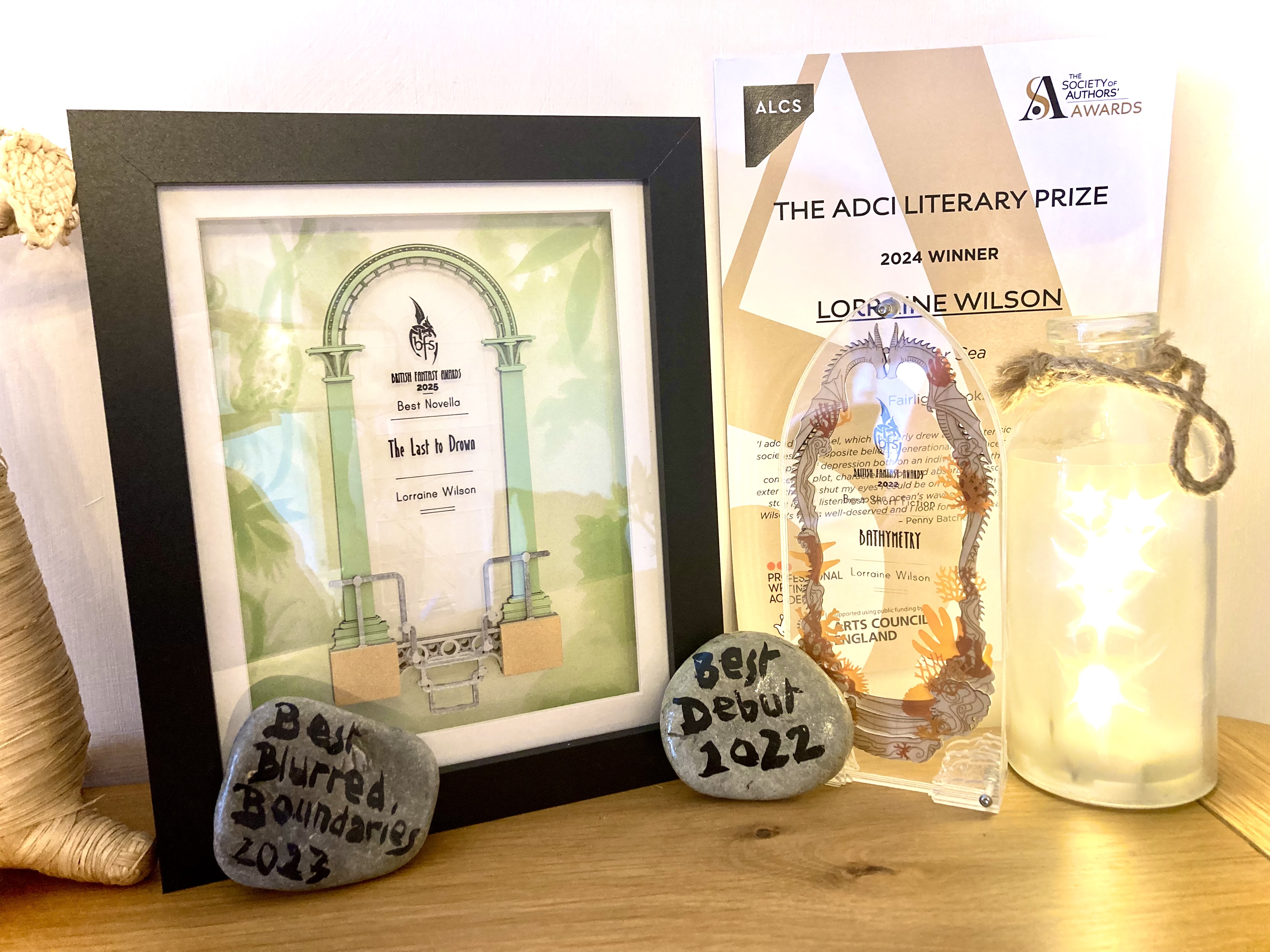
Talking of which, I won an award at WFC! My novella The Last To Drown – a dark Icelandic ghost story about family secrets, chronic pain, the sea and recovering from trauma – won the British Fantasy Award for Best Novella. That’s extremely bloody awesome, and I couldn’t be prouder of this book and of Luna Press who are such a special small press doing amazing work within SFFH.

New award joining its friends

[An aside – Over the last 15 years of chronic migraine, I have learned to temper my emotions because any emotional extreme – good or bad – is a trigger for hours or days of extreme pain, nausea, muscle weakness etc etc. This is a bit of a superpower in publishing, in that while I will have a solid moan to friends sometimes, I can generally roll with the punches with some equanimity. The downside is that I am not very good at just celebrating, because that emotional even keel is so ingrained in me now. Hoo boy am I throwing metaphors around today, I apologise]

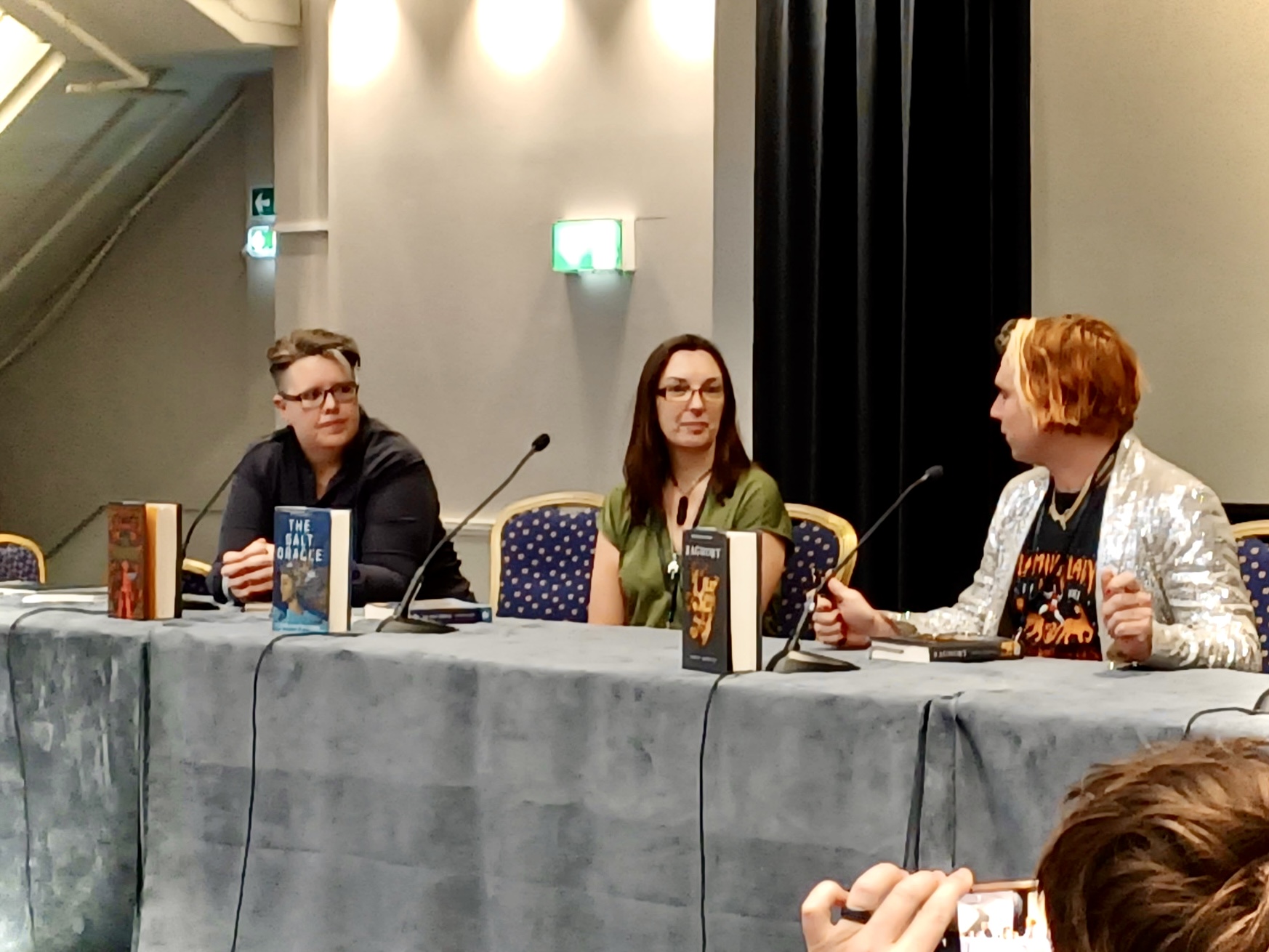
In the last week (at time of writing), I have won this fabulous award, met a lot of lovely readers, launched both Ghosts paperback and The Salt Oracle with a fun event at World Fantasy Con and a friendly signing at my local bookshop, and had a splendid time at WFC besides.

It’s a wonderful, gratitude-inducing position to be in. But whether it’s post-con fatigue, that emotional even keel, or the point in my career, I am finding my overall mental state to be ‘Okay, this is great, but let’s just wait to see whether it means anything‘. Will the early sales mean my editor can (or wants to) open recontracting talks? Will the award provoke interest from submission-list editors? Will early apparent enthusiasm, and mine & my publisher’s hard work mean these books get the momentum to exceed my prior reach?

I really truly hope these books – one for its first flight, and one in this 2nd format – do well, for their own sakes. Because I believe in them, and feel like I did something interesting with both of them. I also hope they do well to reward my editor and marketing team’s championing of them. We’re allowed to say that, aren’t we? Those are acceptable reasons to publicly want your books to succeed.

A little less acceptable, but no less true, is the hope that they do well because I need them to if I’m going to continue to publish. But there is little point dwelling on that hope when it’s 95% out of my hands. So as always, my question to myself when staring publishing in the face is ‘what can I actually do?’

  • I can keep working to organise events & publicity, and be as open as possible to my publicist’s suggestions and opportunities.
  • I can manage my spoons and my outlook so I am well enough to treasure all the positive things coming my way, and keep the negatives in perspective.
  • I can eat some emergency chocolate.
  • And, of course, I can work on something new. Aside from winning an award or selling lots, I can’t influence the success of books currently out on submission to editors, so the only thing I can do right now to maximise my chances of selling more books is to write another one. Write a better one, or a more pitchable one, or just a luckier one.
Launching alongside splendid authors Sam K Horton & (half of) MK Hardy

Technically, the point in the publication process where your book is fully out of your hands (editorially) is the page proofs checking stage. After that, you can’t change anything and it’s entirely up to readers to either connect with it or not. You get no further say on how your words land. But between proofs and publication you have a window of relative calm where a small number of reviewers and authors are reading the book but the wider public are yet to join the conversation. So publication day, for all that other things diffuse the singularity of the day itself, is still a huge shift in the life of a book.

That’s scary, but also freeing. I believe a book is unique to every reader who finds it, because a book is a conversation with that reader – their experiences and imagination and heart. That’s why the same book lands so differently with different people, because it is different. So finding out what your book became in different readers’ minds is a marvel, and stands apart from what your book is to you.

In my opinion, and as with so many things in publishing, it’s important to separate out your relationship with your craft, from your relationship with the publishing industry. A book release is worthy of celebrating because you should be proud of your own craft, and excited for that story to find the readers who will love it. It’s worth holding a little bit in perspective because you need to maintain your publicity momentum beyond this week, or even this month; and you need to maintain your writing momentum entirely beyond this book.

I am guilty of pinning all my hopes on this book sometimes, of focusing on how much is riding on this one doing better than the previous ones according to one measure or another. And there’s enough truth in that to overwhelm the joy of publication day, or award wins, if I’m not careful. So perspective, even keels and focusing on what I can do is good, but taking a wee moment to feel proud of myself independent of publishing’s shenanigans is just as important.

So please wish these books luck on their maiden flights, and meanwhile I will be diving into the edits and pretending that my next article will not be a Christmas reading recommendations post (scream).

Thank you as always for your support. Because accessibility in publishing is important to me, I keep all my craft and publishing posts free, so any shares or tips are greatly appreciated. Wishing you a fabulous weekend.
Introducing The Salt Oracle

Well, my loves, I promised a proper introduction to my next book, and ta da! Here finally it is! Along with a deep dive into how I navigated a challenging developmental edit process, which I hope will prove useful/comforting to you if you ever face similar.

[This article was published on my Substack in early April and forms a part of a regular ‘Diary’ series of posts diving into the publishing process for my individual books].

As you may have gathered from the last newsletter, The Salt Oracle is coming out in November this year, and is set in the same post-internet digital ghosts future as We Are All Ghosts In The Forest, but is another stand alone. Because of my appalling series staying power (or lack thereof) I am rather loving the rise of same world standalones at the moment and am delighted to have accidentally fallen in line with a kind-of trend. For the one and perhaps only time in my publishing life!

These Diary posts are usually a wee behind the scenes perk for my paying subscribers but I figure as this is by way of an introduction, I’ll keep this one public. As well as telling you a wee bit about the book and where it’s at, I thought it also might be interesting to talk about the developmental editing round I recently finished on this beasty. Because, let me tell you, it was tricky. And, well, difficult publishing things are generally useful publishing things to share, right? So strap in…

The book

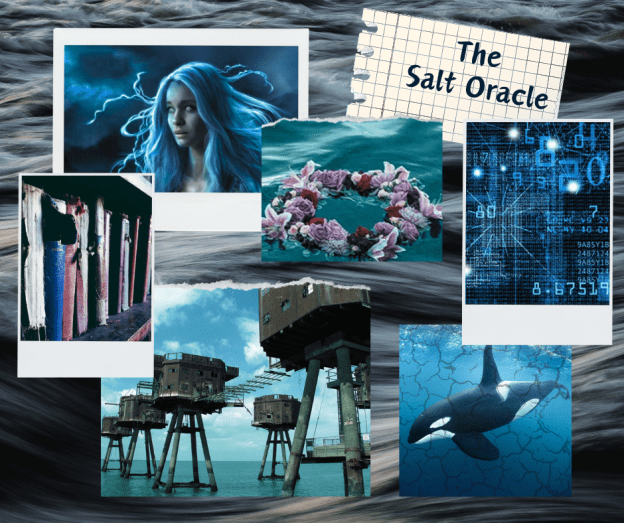
This book is my take on Dark Academia, set on a floating college fortress in the Baltic Sea where her mentor’s murder thrusts a quiet researcher onto a path towards discovering the secrets behind the strange, deadly Oracle child that the college guards so carefully.

If We Are All Ghosts In The Forest was built on the folklore of forests, then The Salt Oracle is built on the folklore of the sea. It’s about our relationship with the sea, as much as it is my character’s relationship with the college she loves, and it’s full of darkness and terrible choices, and perhaps, just perhaps a whole lot of love too.

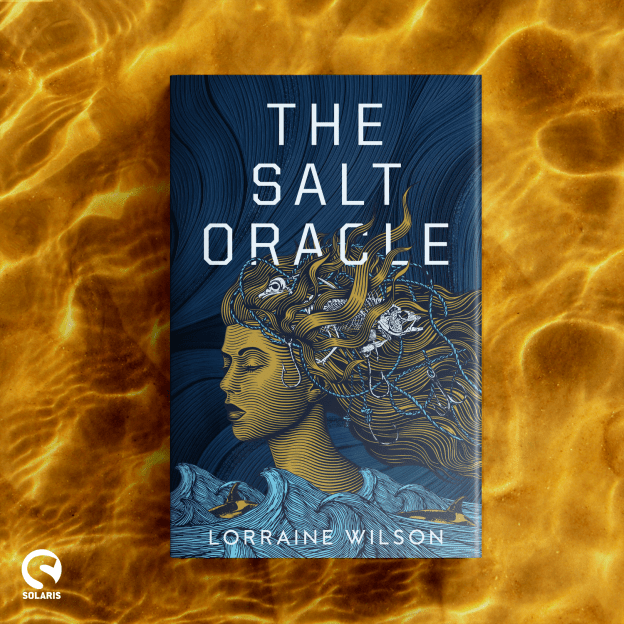
The cover for this book, as revealed in the last article, is to die for, and might in fact be my favourite book cover to date. Although let’s be honest, I have been really, really lucky with all my covers so far.

The Edit Letter

I’ve written before about dealing with the Edit Letter for We Are All Ghosts In The Forest (and Edit Letters in general), but to paraphrase, the Edit Letter is the foundation of editorial input on a manuscript from your editor (or agent, although those notes are often less formal). It tends to be a breakdown of big overarching issues, and then smaller more specific areas to address. Sometimes with a by-chapter breakdown and/or marked up manuscript.

My Ghosts edits were extremely light, but I knew Salt Oracle would be a different kettle of fish because it was significantly less polished when I sent it to my editor. That’s fairly normal for a contract book – you’re likely to be working to tighter deadlines and with less agent input before your editor sees it, so they are generally not scared off by a rougher second book.

But the edits I got for Salt Oracle were by some margin the most comprehensive edits I’ve yet received – 19 whole pages of overarching issues and by-chapter breakdown – and there were a few things in the mix there that meant they initially really knocked me for six:

  • I came away from reading the Edit Letter convinced my editor hated the book.
  • The edits were, for very valid reasons, later than anticipated so I felt very pressed for time.
  • The edits asked for changes that would shift the feel of the book’s setting significantly, and I wasn’t convinced it would work.
  • I was told I needed to cut my book’s length by over 20%. From 126k to 100k words.

Now, that first one can be put down to an over-sensitive author being over-sensitive. But it actually raised an interesting nuance to publishing that I think is worth talking about, hence its inclusion.

I got these edits just before Christmas 2024, and spent much of Christmas in a bit of a blue funk. I’m used to needing a few solid sulking days after getting an edit in, so at first this didn’t much bother me. I expected solutions to form in my mind, and the doubts and worries to morph into enthusiasm, because they had done before. But they didn’t.

I planned out my edits. The doubts and fears didn’t pass.

I started the edits. They still didn’t pass. In fact, if anything they were getting worse.

So around about New Year, I stopped and really looked at why I was reacting so negatively to the edits and what I could do about it. That, more than the details of the edit letter itself, is what I wanted to talk about here, as that’s what might prove useful to others if they too find themselves stuck.

Did my editor hate the book?

My editor had offered a call from the outset, but I usually prefer to just check in by email if I get stuck on anything particular and otherwise sort things out myself. Come early January, I realised I needed to talk some things through, and we jumped on a call. This call addressed a few things, but most importantly this first question.

And of course, no, she didn’t hate the book. She loved much about it, and the characters, the dilemmas and the messages of the book had struck home perfectly. Which was nice.

Something we talked about on the call though was the difference between an edit letter on an acquired book and an edit letter on a contract book. Because I realised that at what will be Book Six in my career, this was my first time with a contract book, and so my first time working with an editor on a book they hadn’t fallen in love with enough to fight for through acquisitions.

When an editor acquires your book, you know beyond doubt that they love it. So when they send an edit letter, you know it’s coming from a place of absolutely being on Team This Book.

Conversely when you have just yeeted a book at your editor that they maybe saw a rough pitch of over a year ago … you do not start with that same assurance.

It sounds a small detail. But when you are facing pages and pages of ‘this needs fixing’, not knowing whether there’s a preceeding ‘I love this but-’ matters. It’s hard processing pages of criticism, so you want to know whether the feeling behind them was ‘this is great, but let’s make it better’, or ‘ye gods why have I been cursed with this’.

This was, I think, a useful lesson for both of us in openness and taking the time to make sure we both know what the other is thinking. It made me incredibly grateful to have a relationship with my editor that makes these conversations easy and positive.

Time pressures

Again, on the call and follow up emails this was a source of anxiety that my editor was able to almost entirely remove.

We shifted the delivery deadline from mid-February to early March, with the knowledge that I could shift it further if need be without it impacting the publication date (which was my biggest worry). Shifting too much further would start to impact our ability to get ARCs out to reviewers though, as well, frankly, as bleeding into time I’d scheduled for other projects. So I didn’t want the deadline to slide too much. But it was very reassuring to know I wasn’t at risk of losing my late 2025 publishing slot.

Edits that don’t feel ‘right’

There were two overarching ‘structure’ changes my editor requested. One was to cut out the wider state-level politics to keep the threats surrounding the College more direct and tangible. The other was to cut the number of characters by some way, as it currently felt too confusing with many of them mentioned too briefly to stick in the mind.

The state-level politics was a fairly easy fix, although the College still needed external connections, otherwise how was it funded? So I’ve not been able to cut all ties to the wider world, and instead have replaced state politics with the politics of appeasing multiple contractors and a university main office. At the outset therfore, I wasn’t sure this background change would really improve the book materially.

The character cull was trickier. I had intended the College to feel like a busy, multifaceted research organisation, full of disparate teams all with their internecine rivalries and my main character isolated within it all. Cutting a lot of characters would fundamentally shift the nature of the College from busy academic institution to small research outpost. More of a remote field station than a center of learning. That’s quite the vibe change, and I wasn’t sure I liked it – I felt it was important that the College look successful For Reasons.

But my approach to edits I’m unsure of is generally to try them and then decide, so that’s what I did. After making sure I had back up copies of the book!

Now it’s done, I think shifting the College’s management structure from political to contractual has simplified and tightened things in a way that works nicely. The move from busy to small I also think now works well – I have leaned into the idea of the College being half-empty due to the umm… attrition rate (!), and the echoing spaces and survivorship atmosphere add some vibes to the book that I wasn’t initially looking for but that I think are pretty cool. And yes, it’s easier to keep track of the characters now too. So although at first I was really hesitant about these edits, guess what? My editor was right? Curses.

Cutting word counts

Perhaps, now I’m out the other end of this edit, this was the trickiest issue of them all. You see, although a good amount of tightening and cleaning up of the prose was definitely needed, the main driver behind the 20% wordcount cut was actually the high price of paper and printing at the moment.

It is, it turns out, one thing to make any number of edits that are intended to make your book better. It’s a whole other thing to make edits to your book that are primarily about making it cheaper. I worried that in cutting words which didn’t strictly need it, I was stripping my book of some of its nuance, its subtlety, its beauty. And as I wrote about recently, I like that stuff! So that editing pass felt rather soulless, if I’m honest, which was a shock – editing is something I generally enjoy and that gets me excited about the book.

I absolutely understand the requirement. Publishing margins for independent presses are under very real pressure from printing costs alongside other factors. So I don’t resent the expectation, although I will endeavour not to be in this position in future (by having those conversations at the contract stage, I imagine, so I’m not caught unawares).

Fortunately having read the shorter version, it does still have nuance and subtlety and beauty. The book’s themes still feel vibrant and strong, perhaps more so for the (relatively) pared back prose matching the vibes. Plus, the cuts have helped me sort out several plot tangles and hone the pacing. It is still, vitally, the book I wanted to write and a story I am very proud of. Honestly, being forced to cut so much whilst not losing the feel of the book has probably been a useful experience for someone like me, who does love a long sentence.

But where I was able to put to rest all my other worries about this book and its edits, this one remained. It wasn’t until I got comments and line edits back from my editor last week that I knew I’d nailed the challenge – my editor was delighted and my line edits took me less than two days. *cue celebratory dancing*

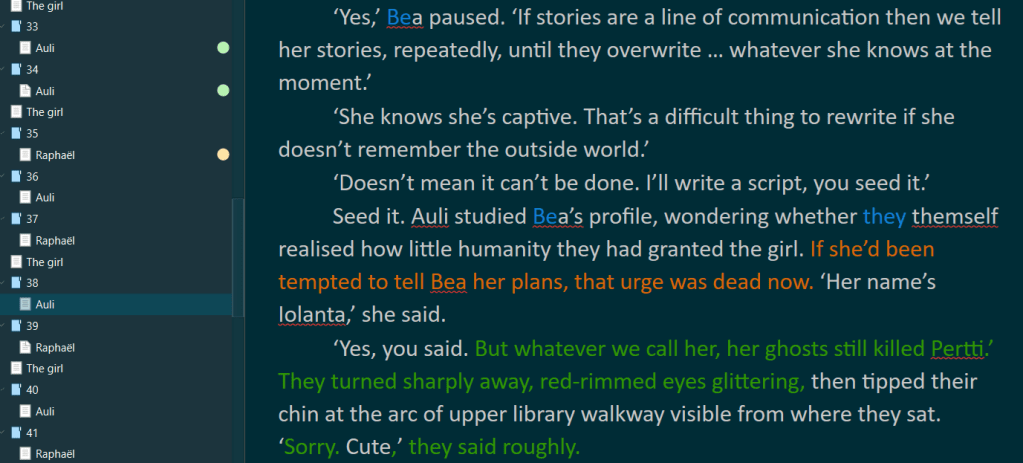
An in-progress editing screenshot from Scrivener showing three different edit passes as different coloured text. This let me keep track of what I had changed & why.

The actual editing process

Just a quick note here, in case anyone is wondering how I went about such a big edit. The answer is I broke it up into five separate edit passes dealing with different things each time. I dealt with all the actual editorial changes on the first three passes, then did a Big Cut pass where I focused purely on cutting words, then finally did a kindle read-through to catch errors, smooth out over-edited bits, and generally reassure myself that it still worked and I still liked it.

It does and I do. Fortunately.


So, there it is, the next book in all its complicated glory. I love it, and I hope you will too when it reaches you. But man, this one has put me through my paces. It’s been a valuable learning curve though – both in terms of my process, and in being able to continue loving a book through all its permutations.

Thank you for reading and I wish you all a relaxing weekend.

Interiority, quiet stories and ‘tv brain’

I crawled out of the editing cave recently to ramble about interiority. Please blame any incoherence on my brain currently resembling overcooked spaghetti.

A wee while ago I read two fascinating articles on Substack.

The first was by Kern Carter, who interogated a few extremely successful books and posed the question – have we lost trust in readers? They were talking about a trend in modern books towards explicitly stating the themes of the book in often heavy-handed ways, rather than trusting the story (and the reader) do the work of building that theme more subtly.

The second article was by the ever thoughtful Lincoln Michel where he proposed that the move away from interiority in fiction, and towards ‘describing a video’ narrative style stems from our inundation with the visual medium for story telling – basically that we are approaching prose as if we are narrating a movie, and thus losing the very thing that makes prose unique (the ability to experience a narrator’s emotional landscape) by replacing it with a poor replica of the thing that makes visual media unique (scenic immediacy).

Both these articles are very worthwhile reads, and seem to be approaching overlapping questions from different angles – is the way we tell stories changing? And why might we be moving towards surface-level narration, where everything from scenery and action to emotions and themes is spelled out to the reader, and nuanced interiority is minimal to non-existent?

This question I think feeds into an internal conversation I’ve been having with myself for some time, about why my books get consistently called ‘quiet’ when they involve death, heartbreak, trauma and threat. To be clear, I don’t object to my books being labelled ‘quiet’ at all, if that’s how they feel to readers then that’s perfectly fine – some readers will enjoy that, some won’t, them’s the breaks etc. It just all feels interconnected to me – a move in fiction towards books that focus on external narration, where everything must be described as if through a camera. And where there isn’t the page time – or the trust in readers – for exploring nuance or emotional complexity or for layering subtext.

[Obvious caveat – these are sweeping generalisations, #notallbooks, and this isn’t even necessarily a criticism of craft. Readers clearly enjoy these books, so they are fulfilling their purpose perfectly well]

But what might be driving a movement away from interiority and subtlety, and towards ‘tv narration’ and thematic heavy handedness? I think there might be a couple of things at play.

TV brain

I find it hard to judge the truth of Michel’s proposed ‘tv brain’ because I personally watch very, very little tv/film (for health reasons, not some moral aesthetic). But it makes a lot of sense. If the vast majority of the storytelling we expose ourselves to relies exclusively on camera angles and dialogue to tell us what’s happening, then it follows that our sense of how storytelling works will be shaped by that. When I think of my favourite scenes in books, I tend to think of a moment of deep emotion for the narrator character – often in an externally quiet scene. Frodo and Sam before the eagles come, Elizabeth reading Darcy’s letter, Lady Macbeth sleepwalking and guilt-ridden. Where-as when I think of favourite moments in films, they are often about the visuals – the beacons being lit, the lake scene (!), the witches on the moor…

I think approaching scene descriptions in terms of camera angles can be really interesting, but only if that camera angle is connected to your character’s inner self. If you are just panning around in Michel’s cited ‘reaction shot’, or describing things because you, the writer, can picture them, then there’s little depth to that. Conversely how your character choses to describe a scene, whose reactions they pay attention to, what all those things make them feel? That’s interesting.

From how I read Michel’s piece, I got the impression he was talking of more plot-forward books, where the character lens is not being applied to the author’s ‘camera’ and is never turned on the character themselves. Which definitely fits with some of my reading in those genre-spaces, where the narrative, even in first person, feels rather … anonymous. I’ve heard several writers say their books come to them as movies playing in their minds that they then simply transcribe. Which sounds a fascinating process, to be honest, but also suggests that it would be very easy to forgo interiority entirely if for them, the characters are figures in front of a camera, not minds that they have to navigate through.

Academia brain

Now, like I say, I got the impression that Michel was talking about books that fit into more plot-forward genres. Where-as ‘academia brain’ is what I think might be happening in the case of the books Carter cites – which sit in more book club/literary spaces.

The thing with people who (learn to) write in academic settings – whether that’s an MA course, one of the big creative writing courses like the Faber Academy, or with people who are themselves academics – is that I think the academic structure breeds a certain defensiveness into your writing. (Confession: I have not attended any such course, but I have been an academic albeit in science, so I am at least nominally familiar with the kind of environment we’re talking about. I’ve also been part of several critique groups, some more formal than others, and I think the same theory applies to them although to a far lesser degree.)

Imagine it – you sit down to write a scene that carries some important thematic or emotional weight in your story, and you write it knowing that it’s getting critiqued next week in a room full of peers and superiors. You know these isolated segments of prose are going to be scrutinised and questioned, in depth, and that you might need to have responses to explain or justify what you’ve written.

Don’t get me wrong, critique can be a wonderful thing, and learning the craft of writing can’t really happen without it, in one form or another. So I’m absolutely not saying critique in itself is bad. But I do think that if you write with critique hanging over you, especially critique connected to grades and qualifications, then you are going to write defensively.

You are going to write to a set of rules that you can point at to justify your choices – whether that’s a clear plot structure, or adherence to staples like ‘show don’t tell’, or ‘every word must earn its place’. You are also, and I think this is the important bit, going to distance yourself emotionally from your writing. You have to, right? It’s going to get torn apart on Monday – you can’t pick yourself up from that week after week if you are bleeding onto the page.

So what you end up with are books written in what I call, perhaps unfairly, the ‘MA voice’. This is technically brilliant writing. It’s beautifully structured and crafted from the plot to the sentence level, observed with detail and thought. But it also makes absolutely sure its ‘message’ is clearly stated (so no-one misses it in critique). And through out all of this, it holds itself apart from both the characters and the readers – it often stays, to get technical, at the same Psychic Distance the entire time, regardless of whether the narrator is brewing tea or dying. It reads like a summer noon – everything is wonderfully, vividly lit and exactly where you’d expect it to be; but there are no shadows, no uncertainty, no depth.

I have read and adored many, many an ‘MA voice’ book, but equally often (and even during those beloved books) I have wanted to holler Psychic Distance, for the love of cheese at the author. Which I think is the same as hollering take some risks, or let me figure this out myself, or (in full Alan Rickman Sherrif of Nottingham voice) make it hurt more.

Popcorn brain

A third thing that might be happening is centred around what we call ‘Booktok Books’ – commercial, plot-driven books in very specific subgenres, that rely heavily in both marketing and writing on a series of popular tropes. I’m most familiar with the portion of the romantasy world that sits here, with its obsession for ‘touch him and die’, ‘only one bed’, ‘enemies to lovers’ and so on. But I know there are equivalencies within other super popular subgenres too. These books not only lean heavily into tropes, but also into character archetypes – the kickass female lead, the misfit outsider, the broody villain, the cinnamon roll, the chaotic disaster.

The popularity of these books (and much of commercial fiction) lies in the fact that they are ‘popcorn books’ – they are familar, easy, fun and moreish. You know exactly what you’re getting with these books and they ask very little of you other than your enjoyment. The worlds, the plot, the psychological arcs of these characters fit neatly into known patterns so the writer doesn’t need to spend time deepening them – they can instead crack on with the fun stuff – which in this subset of romantasy is essentially the tropes and the banter.

Again – no criticism. I love me a popcorn book sometimes, they’re a lot of fun, and many of them are doing what they set out to do extremely well. But these books need to keep plot happening, so they move through any emotionality with the speed of a bullet train. Here, look, some trauma. Excellent, let’s get back to the stabbing/kissing/both.

And thus, in a different market space and for different reasons to the above, you end up in a very similar place regarding emotional nuance and interiority – as in, there isn’t much of either.

So, goodbye interiority, huh?

Well, obviously, again, #notallbooks. But yes, I do feel like there’s a bit of a move away from allowing space to really inhabit a character’s mind. And as I’ve explored above, that’s crucially happening across the literary spectrum. You could argue that the very commercial fiction has never particularly cared to inhabit its characters, only to use them as vehicles for an exciting plot. I think that’s doing a disservice to commercial fiction, to be honest. But that this same shift to surface-level narration is also evident in more literary books suggests it’s a wider tide change.

Why though?

Is it, as is always pointed at, shrinking attention spans? Are we too distracted and busy to want to know a character’s thinking, so we just want to see what they do next and be neatly told why?

Is it writer self-defense? The defensiveness I suggest above could easily be creeping into influencing ever-more-online authors, ever-more-exposed to bad reviews, career vulnerability, and the pressure to appeal to the latest marketing trend.

Is it publisher conservatism? Books that move a little slower, or try something a bit unexpected, are probably harder to market than a book that fits exactly into the mould of dozens of other successful books. Books that don’t explicitly spell out their themes are probably harder to market than a book that thrusts its core theme at you with all the subtlety of a sledgehammer.

…I’m gonna go with d) all of the above please Alice.

BUT

Interiority is good! Strange and unexpected and subtle are good!

Look at Orbital – recent winner of the Booker Prize. It might not be everyone’s cup of tea but it was a very well crafted and pretty much entirely introspective, quiet story.

How about Nghi Vo’s Singing Hills Cycle books – none of them complying with modern conflict centred plot structures and yet all of them powerful and lovely, and laden with award recognition.

Noticeable perhaps that these books achieved, at least initially, greater award recognition than commercial success. But they and others like them prove that there is a readership out there for books that trust the reader to care about the characters’ minds, not just their bodies. And I think giving readers books that take the time to explore nuance and complexity is vital – always, but perhaps more than ever now, in an age where powerful factions would like to strip public debate of all nuance in order to make us easier to silence. Perhaps more than ever now, in an age where we as a society and as individuals are facing choices that have no simple answers. We need fiction that isn’t afraid to get into the weeds of our tangled minds. Fiction that refuses to skim over the surface of the dark things, refuses to provide neatly wrapped and reductive answers to hard questions.

Well, would you believe it this has ended up being longer than I planned. Yet again.

So to try to draw my own muddled conclusion from all this. I think it’s worth thinking about what we ask of the books we read, and what they ask of us. And I think it’s worth celebrating the books that take the time to play in the shadows.

Thank you for reading and if you enjoyed this, please subscribe below to receive these posts in your inbox. Or if you want these articles a bit earlier, plus additional behind the scenes publishing diaries, please consider subscribing to my Substack here.

A year in review, a year in anticipation

A year of writing – the numbers and why they don’t matter.

Welcome to 2025! (late but don’t judge, we have approximately 16 milliseconds of daylight this time of year, I’m 90% dozy bear)

Being as I talk the talk about resilience and not falling into the traps of comparanoia or shifting goalposts, I figure I ought to walk the walk with a wee review post about where I am and how I feel about that.

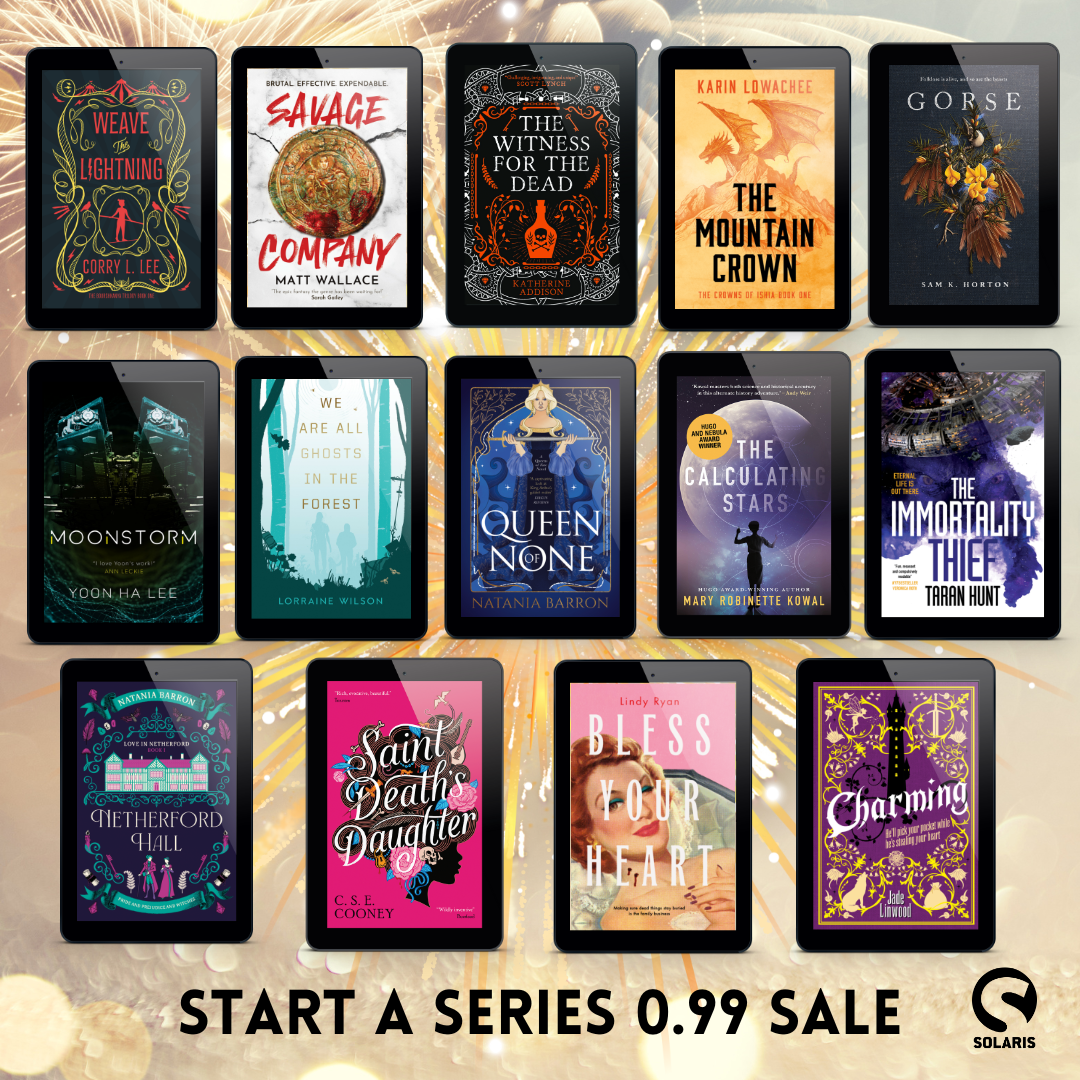
First though, a lil book sale treat – my publishers for We Are All Ghosts In The Forest are running a 99p ebook sale for firsts-in-series from now until the 18th Jan. Which means you can snag a copy of Ghosts for a bargain price if you’re quick (and maybe some other excellent books too?). Click here to shop!

Now then. Down to business.

The year in review

What are the stats for 2024?

I published 1 novella – The Last To Drown, 1 novel – We Are All Ghosts In The Forest, and 1 short story – Mhairi Aird in the Nova Scotia 2 anthology.

I was longlisted for 2 awards (BSFA and Kavya Prize for Mother Sea), shortlisted for 1 award (Kavya Prize for The Last To Drown) and won 1 award (the Society of Authors ADCI Prize for Mother Sea).

I left one agent and signed with another.

I attended two festivals/conventions, took part in oh god I don’t know … a whole bunch of events.

I wrote & revised 1 novella, fully revised 2 novels, and got a 3rd novel through copyedits & proofs. And I wrote 85k of a 4th novel. Totaling about 120k written, 340k edited.

I signed no new publishing contracts, got no new books out on submission, and (lol) received no further parts of my advance because of delays to edits. So my writing income last year was solely from royalties on my previous books, the short story sale, and writing-adjacent work like workshops and this Substack (thank you!).


The year in anticipation

What’s on the programme for 2025?

I will be publishing 1 novel (The Salt Oracle).

I will finish & revise the current wip. Edit/copyedit/proof The Salt Oracle, and edit 1 further novel & 1 novella.

I should be going on submission with that 1 novel and 1 novella.

I will be at two festivals/conventions (Cymera Festival & World Fantasy Con), plus a bunch of other events & podcasts tbc.

How’s about the wishlist for 2025?

That I sell both submissions to good people for good deals.

That I maybe get some foreign rights sold.

That I get all or most of another book drafted.

That The Last To Drown and We Are All Ghosts In The Forest maybe get an award listing or two.


What does it all even mean though?

So how do these stats look to you? Busy? Easy? Perhaps wildly ambitious, perhaps laughably unambitious? It will depend on your viewpoint, right? Your own current ‘normals’. And that’s sort of why I have listed them all out – to say that they don’t really matter.

The number of words I write, the number of events I do, the number of awards listings (especially those omg) or trade reviews or sales … those make for some nice neat numbers but do they mean anything to me, the writer alone (plus cats) at my laptop? They’re all to varying degrees out of my control after all – even how much I get to write is influenced by other people’s editorial timelines, the amount of publicity interest in my newest book, and my health. So when I look back at 2024 or look forward to 2025, what can I take from these lists that really truly intrinsically reflects on me and my writing?

I’ve been mulling over this because as I saw everyone posting their ‘my writing year’ type posts I got increasingly squinty eyed about how good that sort of framing actually is. It’s nice to look at concrete things and pat yourself on the pat, or set a particular aim and work towards it. It can also be really helpful to track these things so you can appraise your relationship with writing/publishing and make any necessary changes. So no shade on tracking these stats at all – I do it all myself, hence being able to reel off the lists above without much thought. And my god, we should celebrate our wins at any opportunity, shouldn’t we? Smell the roses every time, because publishing is a hell of a briar patch.

I came up with two reasons though, why I think these particular roses – these lists of achievements – can sometimes be … maybe not unhelpful, but an incomplete picture.

Reason one is simply the comparanoia of it all. Have you looked at other people’s statistics and Had Sads because yours don’t match up? Or looked at your own previous years and Had Sads because you’ve dropped off in some area or another? Yeah, me too. But if we measure our success or productivity or writerly brownie points by fixed metrics – words written or events held or contracts signed – we are holding ourself to metrics that are (at least partly) out of our control. Which aint all that healthy, folks.

The second reason is that I want to think my creativity matters more to me than my output. I mean yes, I need the output to, you know, have books to sell and hence a hope of a career. So of course words written/books sold/awards won matters. If I look back at 2024 though, while I am extremely proud of the high points on that list, I am perhaps most proud of something that’s not on the list at all – the way in which I’ve pushed my craft.

As I think I’ve talked about a few times, I like to feel that I am trying something new-to-me with everything I write – challenging myself to always be growing as a writer. And honestly, I am really excited by the things I’ve done in Novella2 (which I wrote about here) and the current wip. They are both in their own way taking risks I’ve not been brave enough to take until now, and I think I’m pulling it off. Which is so incredibly cool, I can’t even tell you.

Everything else I did last year, from the simple number of hours I got to write to the joy of winning an award, was connected to other people & other factors. My craft though? That win is wholly and entirely my own.

Which means that whatever those other people & other factors are doing in 2025, I can hold one ambition entirely independent of all that uncertainty – challenging my craft in a new way. If I can succeed in that one thing, then that’s something to be proud of and excited by even if some of my statistics look worse compared to 2024. (They will – I’m not going to get two books out in 2025, let alone a bonus short story, so from the get-go I’m a man down, so to speak).

Depending on other things (lol, see?), my next projects may be pushing me in really, really structural ways, or in attempting a new subgenre, or maybe something that’s going to be so tricksy narratively… I am excited by all these ideas, but I’ve honestly no idea which one will be next on the drafting board.

So do I have a point? Yes!

It is that listing your achievements and ambitions can be really fun, a useful gauge, and an opportunity to take stock and celebrate your awesomeness. But that the most important metric of you as a writer, far more than the subjective whimsy of publishing successes, is whether you are finding joy in your art. (Or catharsis. Or hope. Or freedom.) (Or revenge)


So my gorgeous creatures, may 2025 bring you publishing joys but may it also bring you wonder and courage in your writing. If you want to stay up to date with my blog posts please consider subscribing to my Substack as that’s where I’m most active.

Publication day waffle

The book, the backstory, the question, and my hopes.

I have grown a habit without plan or forethought, of posting on/around each new book’s publication with my thoughts on what that particular book means to me and where it came from. For Mother Sea, that post was an explanation of the content warnings for the book, for The Last To Drown it was about the experience of writing chronic pain and the craft of novella writing.

With the publication of We Are All Ghosts In The Forest this week, I have been attacked by a fit of the pensives again and wanted to do the same for this book. Because the weird thing about publishing multiple books is that each one somehow means something unique to you. It’s important to you in an entirely different way to your previous (and likely next) books. Which when I type it, sounds perfectly reasonable, but I don’t know – I think a part of me was under the impression that publishing books would become … not rote because obviously each book is unique, but that the act of publication at least would become familiar and comfortable. Like wearing different outfits every day but then slipping into the same coat to go out.

And yes, there are aspects of the publication hullabaloo that feel very different (mostly less fraught) than they did the first time round simply because we’ve been here before. But Ghosts does have its own new territory to break, both personally and professionally, and I guess that’s where I’m gonna go with this publication day (weekend) waffle. Alongside a lot of shiny promo graphics that my fab publicity person sent me & I can’t resist using!

Craft, learning and lockdown.

One of my writer hopes is that each new book I embark on will teach me something new about writing. It’ll push me in a slightly different direction – whether that’s in genre or subject matter, form or voice – so that with every project I am challenging myself to grow as a writer. I aspire to be braver at this, if I’m honest with you, to be bolder in leaping into things I’m not sure I can pull off, more fearless (or unhinged, your choice) in being willing to tear something down that’s merely ‘good enough’ and rebuild something better from the ruins.

However, that’s for the future. For Ghosts, I look at it and think that the best lesson I learned from it is to trust in the small flashes of wonder more. To not get stalled on ‘yes but how does that work’ until the editing, to leap merrily into a half-arsed shiny idea without the comfort of the usual planning I do. I don’t think I’ll ever be someone who regularly writes without a good map (of character psychology and setting at least), because that stage does feel important and enriching to me. But I think there’s real value in knowing you aren’t tied to that planning. That sometimes, when the wind and the tides are right, you just have to leap aboard, hoist sail, and see what happens.

Which is how Ghosts materialised. At least the initial shape and opening chapters.

See, the thing is, I started writing Ghosts in March 2020.

Mmm hmm. That March 2020. I had a child two terms into their first year of secondary school, just forming new friendship groups, just adjusting to this new world … then suddenly at home, isolated, with their education, friendships and world reduced to pixels.

[See where the idea of the ghosts came from? More on this below…]

Homeschooling in that first lockdown was … not brilliantly structured, so even though I had it undoubtedly easier than parents with younger children, I was still rarely getting more than 20 mins of uninterrupted time. And the vast majority of my attention, emotion, and organising capacity was being used up on my child, which left exactly zero capacity for me to do intelligent, thoughtful things like plan and research and worldbuild.

When I sat down to write Ghosts, I had the opening image in my mind – of a woman returning to a remote village with a stranger boy – in my mind and nothing else.

Two paragraphs in, I mentioned a ghost. The line is ‘There were three people on the street, two of them real’. I wrote that, thought huh, so we’ve got ghosts then, and carried on. By the end of the first chapter – and the appearance of a certain image-shifting cat – I’d realised the ghosts were the remains of the internet, that the village was in Estonia, and that Stefan, the boy, was non-verbal. All my worldbuilding, character development, and plotting began then, and it was a patchwork ad hoc affair that later required a lot (so much) patching up and weaving in of broken threads.

Without the particular circumstances of lockdown and homeschooling, I’d never have written a book with such wild absence of planning. I quite probably won’t again. But thanks to that experience, and to Ghosts as a final product being something I’m quite proud of, my relationship with planning has evolved significantly. I still spend a good amount of time exploring the imagery and layers of the book’s core theme, because that’s the lodestone upon which everything else is built. And I do still plan, but it’s much less ‘I need to know everything before I can start’ and much more ‘I need to know enough not to get too tangled while I’m finding my feet in the opening chapters.’ It’s less character arc graphs, and more floorplans! (I’ve discovered a bit of a love for floorplans with Salt Oracle and the current wip both being largely in one big, complicated building)

Is this growth? Not really. I mean, there’s no wrong or right way to do this, so my approach adjusting doesn’t mean it’s better. But I do feel like this particular change, for me, is about confidence. I trust my instincts more, I trust those flashes of wonder to guide me well; I trust that if I make an unholy mess I can (grumpily) unpick and restitch it. Let’s be honest, I will also always love a graph, but this new more relaxed approach to tackling new projects might just give me the freedom to be bolder in the next project, and the next…

Ghosts and loneliness

There’s always one question that comes up again and again with each book that gets published. One particular theme or issue that stands out enough with enough people to become a feature of most interviews or informal chats about that book. For The Last To Drown it was about the experience of writing chronic pain. For Mother Sea it was questions about the importance of climate fiction.

For Ghosts I think one is already emerging, and it’s going to be ‘Where did you get the idea for these ghosts?’. The easy answer is that scene above – me watching my child struggle through the loneliness of a life reduced to four walls and pixels on a screen. The strange thing is that lockdown wasn’t isolating for me, in fact with both my husband and daughter suddenly in the house all day every day, I lost the peace and solitude I actually relied on quite heavily to manage my chronic pain. Being housebound apart from occasional short trips out? Well, hi, welcome to my world, please tidy up after yourself. BUT it was a horrible experience for my daughter, at an awful point in her life, and watching that was heartbreaking.

The chain of thought from that to a world haunted by fragments of our digital detritus, by our online echoes, is fairly obvious. And then the rest of the world in Ghosts had to be built up around that central concept.

So if anyone reading this was wondering, there’s the answer to that particular question. Where did the ghosts come from? Loneliness and lockdown. Homeschooling, society’s fragility and resilience; most of all the search for connection.

Growth, ladders and doing the daunting things

Ghosts represents something more prosaic to me too. This is the first book in my Solaris contract, and my first book with a publisher that has Big 5 distribution and main player reach within the SFF world. All three of my publishers have been/are amazing, and in my opinion punch above their weight with the quality of their lists, but Solaris are a step into a bigger room for me, if you like.

So Ghosts feels a lot like the next rung in the ladder of my career. It’s exciting. I’m hopefully going to be reaching new audiences with this book, hopefully gaining new readers who’ll stick around for future books. I’m doing more events for Ghosts’ launch than I’ve done for all my previous books’ launches combined! And with some brilliant author friends! My fabulous marketing/publicity goddesses are helping me reach new venues and platforms too. If the reception to Ghosts is positive, that in turn will pave the way for other opportunities (foreign rights sales for Ghosts, further book deals etc).

This is all wonderful new ground to be breaking. I am extremely fond of, and proud of, Ghosts, and am excited to have it out in the world finding people it resonates with. It’s also, not gonna lie, just a teensy bit daunting. I say this because I’m leery of doing the Instagram ‘Everything is intensely wonderful actually’ thing. Several events plus travel in a month is going to be a physical test, but I’m interested to see how I cope and how quickly I recover. It’s good data for the future! There’s also the fear, of course, that no-one will show up to my events, or that everyone will hate the book and hunt me down to tell me so, or, or, or… But those are normal, unavoidable fears to have and I have an ace in my back pocket…

…I have readers. I may not have many compared to other authors, but there are amazing, strange, beautiful people who have come with me from book to book, frequently cheered me on, voted for me, recommended me to others. These readers have trusted me each time I’ve veered off in a new direction. So I trust them in turn. I trust that they’ll read Ghosts and find something worthwhile in it. And that’s kind of all that matters. Yes, I hope I reach new readers as Ghosts takes the stage. Yes, I hope it opens new doors for me and my career. But I hope even more that the readers who’ve supported me thus far will enjoy this next step on my bookish travels.

Thank you for reading & supporting this blog. I’ll be back soon on my Substack with less ‘please buy my book’ and more about what makes a good book event, parting ways with your agent, and more…

A Letter to Debut Authors

This blog was first posted in December 2023 on my Substack, inspired by a few conversations I’d had with authors at various stages of their career, and someone mentioning an article I wrote at the time of my second book’s publication, looking back on my debut year and the things it taught me.

I first wrote it before a spate of Happenings around the 2024 debuts, review bombing and general unpleasant shenanigans, so I then edited it to talk about some of the worries I’d seen folks expressing around GR reviews and debut groups.

If you are a debut author, you’re probably already swimming in a veritable sea of advice, information and general flailing. So I’m not going to talk about debut year. Suffice to say I hope you are finding your path through this exciting, uncertain time and remembering to celebrate the truly amazing thing you’ve achieved.

What I wanted to talk about instead was preparing yourself for what happens next. Because much as the industry likes to put a huge emphasis on debut books and the debut year, this is only the first step on a hopefully-long road. And if I’m honest, I think it would be helpful for a lot of debuts to do a little more looking ahead and a little less staring at the ground beneath their feet, wondering if it’s a pedestal or a cliff edge.

(Hint: it’s both)

There have been several reports recently about mental wellbeing in debut authors, author incomes declining, and the brevity of most authors’ careers. These studies don’t paint a pretty picture of life as an author, and suggest that most of you beautiful, shiny debuts – maybe a whole 80% of you – will not publish more than three books. Only one in ten of you will make it beyond six books. I look at my debut twitter/facebook group and those numbers are already holding true, which is … ugh. Dreary, right?

When we sign that first publishing deal, most of us hope we’re launching a – well, maybe not a career, given those average incomes lol, but definitely a long term publishing journey. So what can we do to try to be one of the minority who last the distance?

[Obvious caveat here: I’m contracted up to book 6 currently, with several more in various stages. So although I’ve not quite made it into the 10% yet, it is looking likely I’ll get there]

[Second obvious caveat: I’m not a Big Name, so my income is definitely on the low side of that author average. I’m not talking about how to be successful here, I’m talking about how to survive]

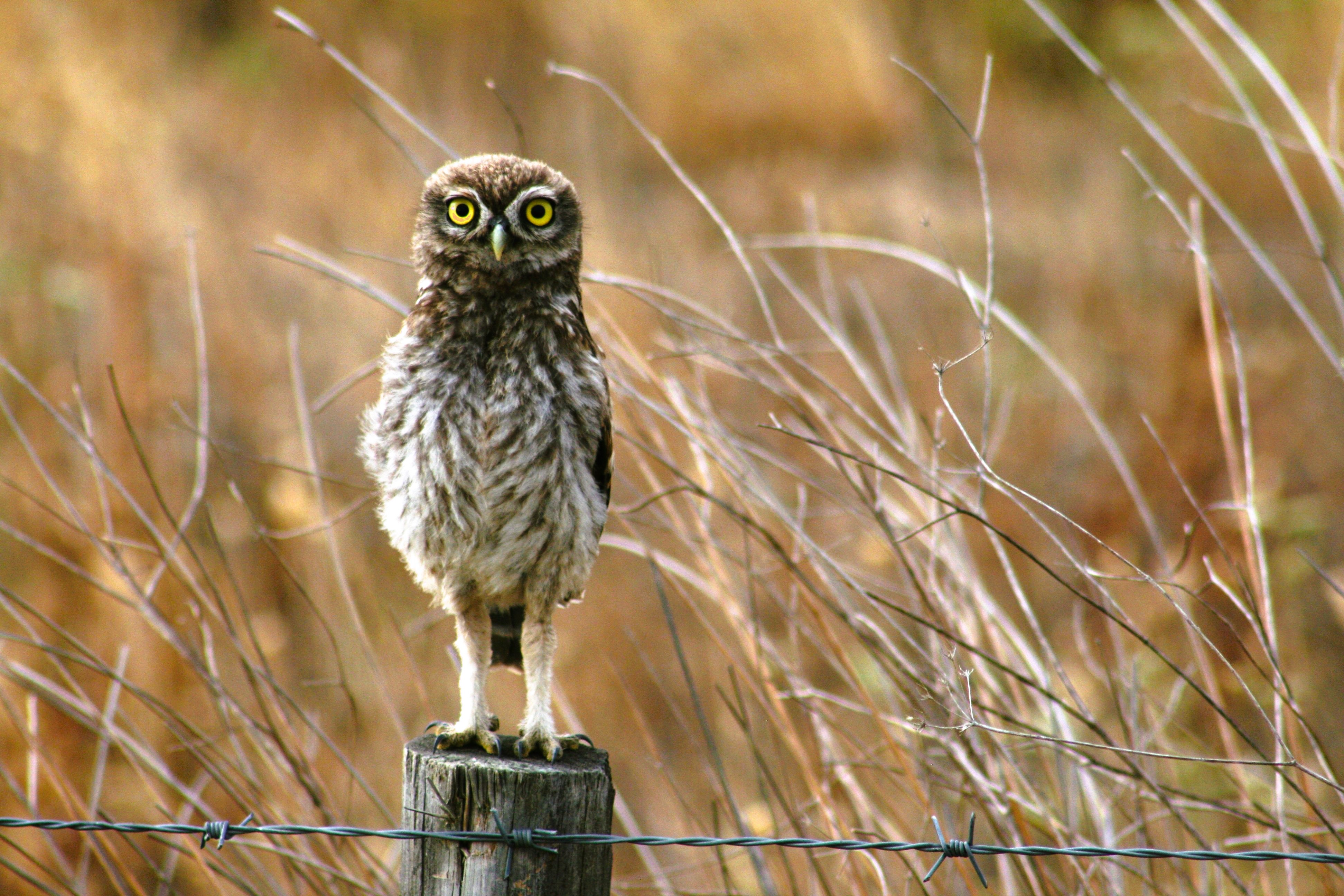
A very wise and elegant owl

So, back to that pedestal/cliff face… If I could tell you anything from four years in, it would be this:

  1. Be aware of the cliff-face, but don’t be paralysed by it. The cliff-face in my tenuous metaphor is the fear we all face that if our book doesn’t sell enough, we won’t get another deal. There is truth in that – poor sales (relative to publisher expectations, which vary ENORMOUSLY between books) will likely lead to smaller advances and/or fewer offers next time around. Publishers are rarely open about the sales figures they have predicted for your book though, so you cannot know with any certainty what’s ‘enough’ and what’s ‘not enough’. Remember they will be in profit long before you earn out your advance, so chances are good that you’ll be okay even if you don’t get an Amazon orange banner or a Sunday Times bestseller number.
BUT even if your book does ‘under-perform’ it is not the end of the road. It just might mean the road looks a little different to the one you anticipated. A lower advance next time still means you are getting a next time, which is great! And there are a lot of publishers of all sizes & visions out there. One of them might be a better home for your next book, maybe even helping it do better than your debut. The adage that nothing sells your book as well as publishing the next one is kinda true – you’re building momentum. Be the bonfire, not the firework, so to speak. And hey, if it’s truly not working, you can always reinvent yourself under a pen name to start afresh! So yes, hope for the best, but don’t tie your whole self to the success of this one book! That way lies way too much anxiety.
  1. Be aware of the pedestal, and the step down. My metaphorical pedestal is the shininess of the debut experience. It’s the way that publishing loves you right now – you’re the untarnished new thing they get to shout about. Everyone around you is telling you how excited they are by you & your book & omg you’ve cracked this whole thing! You’ve won at publishing! Finally!It’s a wonderful feeling! This is something you’ve worked so hard for, probably for many years, and you should bask in the glow of success.

BUT it is a small pedestal, and sadly a not insignificant fraction of the love and attention you’re getting now will wane with your subsequent books when there’s a whole new cohort of debuts to celebrate. So try to build your sense of self as a writer around internal metrics of success, not external buzz. Next year is going feel very different to this one, and the one after that different again. The highs are worth celebrating, but they aren’t worth pinning your energy or your confidence on. Try to focus on the things that are within your control – developing your craft, building a community of bookish friends who genuinely uplift one another, learning new writing-adjacent skills like mentoring, blogging, event chairing etc (which will all help with the first two)remember to stop & smell the flowers

  1. While you’re on the pedestal, don’t throw peanuts at the gallery. It is very tempting to feel like you’ve cracked some secret code and now Have The Answers, but remember you’re working from a sample size of one! Your experience is certainly helpful context for others, but it will not be the Only Way, or necessarily the Best Way for them. The landscape of publishing is mercurial and what worked for you this time around will probably not even hold true for you next time around, let alone anyone else. There are also many routes through publishing and much as some routes get the ticker-tape parade, the truth is no one route is ‘better’ than another when you look at the longevity of authors’ careers.

For example, selling in a highly contested big money auction looks like the dream but it’s a vulnerable place to be, career wise. Whereas selling to a smaller press looks unglamourous but you’re far more likely to earn out your advance & be positioned to ask for a higher one next time. Neither route is ‘better’ or makes you a better or worse author.

When I graduated from my undergrad degree with a 1st class honours, I felt I knew quite a lot actually about zoology. When I graduated from my PhD though, I knew I knew almost nothing and had only barely started learning the skills I needed to progress. Publishing feels a little like that to me. It is a process of constantly learning and relearning both our craft and the publishing experience, and there is no point at which any of us gets to look down on, or claim authority over, anyone else (see my comparanoia post for more on that). This is GOOD! I love that writing is a constant evolution of the self! Sure, financial security and a little less reliance on luck and stochasticity would be nice. But that aside, I love that no-one’s journey is the same and no-one’s books are the same, and we’re all just figuring it out as we go.

Remember to stop and smell the flowers
  1. Okay, this is the bit I’m adding in response to the review bombing furore in the 2024 debut group. For anyone who gets caught up in one of the sporadic debut publishing storms, I’m so sorry your entry into publishing has that added stress. I hope you managed to step back from it when need be & that it doesn’t entirely tarnished the communal joy to be gained from the debut groups you’re part of. A little perspective on reviews and debut groups, for what it’s worth:

First off, a few one star reviews are not going to tank your book. Publishers care (sometimes) about the number of reviews or the number of ‘to reads’ – they don’t care about average ratings. Because every book gets a handful of 1-2 star ratings & everyone accepts that those are both inevitable and meaningless. So if you see this happen to your book, yes it messes with your average and it’s horrible to feel unfairly targeted, but please know it’s not going to harm your book in the grander scheme of things. (For the record, there’s a neat inverse correlation between my average GR rating and the number of award noms/wins my books have, so make of that what you will!)

Secondly, debut groups can be a wonderful way to find your tribe, make connections & generally enjoy sharing the love. Howmsoever. They can also be breeding grounds for misinformation, comparanoia, and bluntly snobbery around publisher or deal size. (see point 3 above!) They also tend to fizzle out as people leave once their book is out or they hit 2nd book deadlines or or or. So my wizened wisdom would be to treat them lightly – make friends, be supportive, but don’t invest more time or emotional energy into the group than you can afford. The benefits to your book of authors (particularly those writing in entirely different genres) sharing your posts are slim in the grand scheme of things, so don’t stick around if the group vibe is not working for you.

This doesn’t need saying, I know, but your fellow writers are not your competition. This industry is tough and a positive community will give you the resilience to build a long term career, so be that community. Viewing (and treating) your potential friends as rivals will only make you more vulnerable to stress and burn out in the long run (and career-damaging public tailspins, as this week has shown).

  1. PACE YOURSELF. Please. Pretty please. I wrote a very long and nerdy blog about the relationship between authors, social media and book sales & if you want to feel empowered to step back from some of your social media then go give it a read. TL:DR book sales aren’t on you, so do what you enjoy and no more. Social media aside, also pace yourself with writing and deadlines. One of the biggest changes that you’re probably now in the middle of is the switch from being able to focus on one book at your own pace prior to publishing, to juggling 2, 3, even 4 (wait *counts on fingers* 7!) active book projects at the same time. With publishers setting editorial deadlines, publicity introducing a whole cavalcade of blogs, podcasts and events all with their own timelines, and your agent gently murmuring that you need to maintain momentum … it’s A Lot. If you need more time, ask for it early. Publishers would much much rather know in advance that you’re gonna be late, and they won’t be annoyed – it is very normal. If you can’t do an event, tell folks as early as possible. Say no to things if you need to. I live with disabling illness so I have to guard my energy pretty carefully. This means asking for generous timelines from the start, and being very careful about what events I say yes to, and how I manage them. Folks are okay with that, as long as you communicate. This is all about building an authorial life that is sustainable for you. What that looks like will be different for each of us, but if you want to avoid burn out & buffer yourself from the worst of the workload stresses, then you need to find your balance and hold tight to it.
  1. And lastly, as mentioned above but it deserves its own bullet point, build your sense of self as a writer around things within your control. Advance size, reviews, media buzz, foiled arcs and book boxes, bestseller lists, awards … all of these things are a) largely subjective, and b) entirely out of your control. If you stake your self-belief as a writer on such flimsy things, you will struggle when that subjectivity inevitably swings the wrong way. They are all wonderful, undoubtedly, but do they define whether you’re any good? Absolutely not. Do they define whether you’re a success? I guess that depends why you write. If you, like me, write to connect with others, then you don’t need an award or an auction to succeed. Instead, try to focus on the wins that are less subjective – the readers who reached out to tell you they cried, the simple fact that a publishing house believed in you enough to commit to your book, the joy of sitting on a stage talking about books with writers you admire. Your friends’ belief in you, that gorgeous scene you wrote yesterday, the art you inspired someone to create. Those are incredible things, and they will carry you further than anything else.

I’m not that much further ahead of you on this road, and I’m not in any way an expert. But if my strange and difficult combination of publishing, disability and marginalisation has given me anything then it’s the ability to hold myself steady through a storm. To view both the highs and the lows as passing weather fronts and focus on my community & the page in front of me. I think that’s why I’m still here, working on what will likely be my 8th & 9th books, mostly sane and still madly in love with writing.

I hope you are proud of yourselves, debut authors. Only 1% of aspiring authors do what you’ve done – so you’re amazing! I hope you can carve space within the madness that is debut year to celebrate this marvellous thing, and ready yourselves for the years and books to come. You’ve come so far, you have so many adventures awaiting you ahead.

Literary versus genre

These two terms and their meanings are something I’ve found myself talking about a fair number of times in interviews, because my writing spans both speculative and literary spaces and has been marketed as both straight SFF and straight literary. Being as I have Opinions, I figured I’d share them with you!

[I shared this post on my Substack a few months ago – to keep up to date with the newest posts, as well as publishing diaries and occasional short fiction, please consider subscribing to my page there]

‘Literary’ is generally used to refer to fiction that prioritises prose style and internal character development over external plot. It also is used (inaccurately) as a marker for books that don’t contain the obvious ‘genre’ ingredients of, say: a detective solving a crime, dragons, a historic setting, romance as the main plot etc.

I say inaccurately, because the writer’s approach to prose, and the contents of the story are clearly two different things. ‘Literary’ is one end of a scale that goes through odd terms like ‘book club’ & ‘accessible’ right the way to ‘commercial’ – which is prose written to focus on the external plot and not the internal.

The contents of the story on the other hand are what determine ‘genre’. Whether that’s mystery or romance, thriller, space opera, family epic or domestic noir – they are all labels that tell you something about the waypoints you’re likely to encounter in the story.

But a book can be both a thriller, and literary. It can be both a historic mystery and commercial. The spectrum of literary-to-commercial exists within each genre. Think Wolf Hall to The Duke And I, or The Fifth Season to The Kaiju Preservation Society. There are some books whose genre is hard to pinpoint – mainly because ‘mid-life crisis’ isn’t an acceptable label apparently so they get lumped into ‘contemporary fiction’ ‘literary fiction’ or ugh ‘women’s fiction’.

We all kinda know this, right? So it annoys me that ‘literary’ is often treated as something separate from (and better than) ‘genre’. When it isn’t (on both counts).

But the truth is that these are all really just marketing terms for booksellers to use to inform & direct readers, which is the main purpose of any genre labels after all. Bookshelves are two dimensional spaces (functionally), and a book has to sit somewhere.

So rather than fight the entire functioning of bookselling, my issue instead is with how the term ‘literary’ is wielded. It comes with a certain stamp of ‘quality’ that generally attracts more trade review inches and award nods. Literary = better, right?

Hmm. But literary also has undertones of older white men writing opaque deconstructions of the agony of being an older white man. It carries associations with ‘The Classics’ and establishment standards of what makes good writing. Which, let’s be honest, is another way of saying literary = western-centric narratives by people who are white, middle/upper class, cis/het/allo, able-bodied and male.

It is a familiar joke among writers that a woman writing about a mid-life crisis is writing ‘women’s fiction’ (ugh) but a man writing about a mid-life crisis is writing ‘literary fiction’. It’s a joke because it’s true. Anyone who doesn’t fit the dominant paradigm sees their stories pigeonholed first by their own identity and only second by the content of the book itself. Which sucks, let’s be honest.

I think perceptions are changing. More non-western voices are appearing on the big literary prize lists, translation prizes are gaining greater profile, and women are consistently more equitably represented on prize lists than they were 20 yrs ago. There’s still progress to be made – we need more global south voices, we need women and other marginalised writers to receive the same respectful language in reviews as men get, but it feels like the default image of a literary author as a narcissistic tweed & cognac toting silver fox is happily on the wane.

Until it’s firmly gone though, establishment preconceptions about what makes a novel literary will continue to act as a form of gatekeeping – sending a message to working class, BIPOC, disabled, queer & women writers that ‘oh honey no, you don’t belong here.’

So when my writing is referred to as literary, a small part of me winces. Because I know some people are put off by the term – it is what ‘that kind of person’ reads (and probably pontificates about). And I’m not gonna lie – the snobbery around the term is alive and kicking in some literary circles, which has been eye opening as I moved from largely SFF events in my first two years as an author to largely literary ones this year.

HOWEVER I think the huge popularity of books that span the literary and genre spaces is helping to erode that elitism bit by bit. Writers like Natasha Pulley, Bridget Collins, Sarah Moss, Martin MacInnes, Sequoia Nagamatsu etc are all challenging the clarity of the dividing lines. I wish some of these authors would embrace their genre audience more, but that’s complicated by SFF conventions not paying authors (and in fact expecting authors to pay to attend, but that’s a whole other post). And also by marketing decisions to set these books in the ‘Fiction’ departments, not the ‘SFF’ ones.

Genre divisions – and reductive marketing labels – aren’t going anywhere. We all know the comfort of picking up a book and knowing exactly what to expect from it – we want the familiarity of a cozy murder mystery or a historic romance sometimes, I definitely do. But I think many of us are also hungry for stories that take us in unexpected directions, that meld genres and challenge our assumptions. That inhabit a familiar world but add a twist of magic.

Likewise many of us love books that are both beautiful to read, and take place in space; or thoughtfully explore grief whilst also solving a murder.

‘Genre-blending’ fiction is on the rise, for good reason, but I think for it to reach its full audience, we need to rid ourselves of the boundary lines between ‘literary’ and ‘genre’. I would pay good money to never again be asked about moving between literary and SFF as if the two were separate islands in a sea of lava!

So in a bid to erase some lines, what’s your fav read that melds genres? Or that leans heavily into literary forms within a genre space? I love Natasha Pulley’s The Kingdoms – a mix of historic suspense and timey wimey alt history. Also can’t go without mentioning the timeless Never Let Me Go by Kazuo Ishiguro. A deeply thoughtful exploration of agency and humanity wrapped up in a terrifying dystopian SF.

Cover Reveal and Some Musings On Cover Development

Today is Cover Reveal Day for We Are All Ghosts In The Forest! I love cover reveal days – they’re the day you can entirely unself-consciously gush about your book because you’re gushing about someone else’s work which removes (almost) all the imposter syndrome, awkward self-promo feels of your standard bookish promo events.

If you’ve managed to miss me hollering on social media – here is the gorgeous creation of Jo Walker, which I think captures so much of the essence of Ghosts from the colour palette to the tiny details.

Rather than just finish the blog here with an I HOPE YOU LOVE IT, I figured it might be interesting to talk through the process of cover designing in trad pub and perhaps share some ideas for how you the author can best intersect with that to increase your chances of getting the cover of your dreams.

Sound good? Okay.

[A version of this blog was shared on my Substack in January. Where-ever you read it, thank you for your interest and support]

I’m not as visual as some, so when I have a finished book my sense of what I want the cover to look like is generally quite vague. For my first book, I could only say ‘I don’t want people’ and ‘Moody, maybe with foxes.’ Which is … well it’s better than nothing. But there are several hundred directions that premise could take and many of them wouldn’t have really fitted my inner vague sense of the book.

Incidentally, I got extremely lucky with my first book in that my publisher spotted a new piece of art by award winning cover artist Daniele Serra and knew instantly that it fitted the book perfect. So my vagueness didn’t shoot me in the foot and I adore my moody fox with no people cover!

Buying the rights to a pre-existing piece of art is a slightly unusual process though. In most cases a book cover is created specifically for the book according to a cover brief given to the artist.

By my second book, I’d figured out that I needed to think more clearly about what I wanted. Now, I look for covers of books that both fit in the same marketing space and have stylistic approaches I like. I look up the designers of covers I admire and check out their portfolios. I try to come up with a list of aims that are more than ‘make it dreamy?’. Such as – ‘I think a minimalist & slightly eerie foresty vibe would work really well’ (Ghosts) or ‘I’d love lush tropical colours, including animals that are motifs in the book, and reference to the sea’ (Mother Sea).

And so for all my subsequent books, I’ve gone to my editor with some comp covers, a set of specific vibes that I want to convey, and some stylistic or design elements I am keen to see.

This step can take the form of a conversation in a bookshop (my second book), some email back and forth about comparative covers and photographs (my third book), or me sharing Pinterest boards and comparative covers, and us both pulling together a list of potential artists (We Are All Ghosts In The Forest).

Once you and your editor have agreed a direction, your editor puts together a cover brief which contains all the above information, along with relevant themes and motifs, plot points and market placement aims. The cover brief my editor put together for Ghosts was amazing (I wish I could share all of it), and incorporated elements from my Pinterest board, many of my suggested cover comparisons, and some incredibly exciting author comps as well.

The next steps happen without author input, usually (but see below).

With the sign off of Marketing and Publicity (and Mysterious Others), this cover brief is then sent to whichever cover artist is hired for the job. We had a list of top favs, and which one we went with was a juggling act of their vision and availability versus our deadlines. The limits of my involvement in this stage was saying ‘fabulous’ once the artist was confirmed.

Normally, the artist provides a selection of initial cover visuals to the publisher and they go through a process of development to come up with a single draft cover before this is then shown to the author.

With my second book, publishing with a small press meant that I was more closely consulted at this stage. I got to see all the prelim draft versions, pick the elements that I liked and ask for fairly substantial changes in an iterative process that went from entire colour/layout changes to tiny tweaks of font size and contrast levels. While this isn’t something I can expect from most books, it was an incredible learning process. (Check out Jay Johnstone here)

With Ghosts, I was sent a draft cover that had already been through revision in-house. It was beautiful, and very much in line with how I’d envisaged it. There were a few tweaks I wanted though, and after consulting my agent to confirm, I sent this list of requests back to my editor. Now, the bottom line in all of this is that the publisher has final say on covers. Contractually, authors are to be consulted, but not obeyed, so to speak.

With Mother Sea, to be honest this draft was so sublime, I made one request about the title font, which was adjusted, and that was it.

I was a little nervous sending a few more tweaks for Ghosts, so was super grateful when my editor came back with ‘Yes, I agree with all of this, will send it on’. Happy days.

I then got sent a ‘final’ version to agree, which was amazing and incorporated all my requests. But there was one small detail I felt still needed tweaking. I asked; this time my editor said ‘maybe. it depends.’ Which is entirely fair. The artist was working on commission and that buys only so many hours of work. So I get it, and even if they couldn’t make that last change, I still fortunately had a cover I love.

Do I have to love it? Maybe not, but I do have to believe it will help sell the book. We are going to be looking at this cover SO MUCH over the next year or so. I’m going to be taking it to bookshops, sharing it online, using it to pitch myself for events. I have to trust that when I show it to someone, it will give them both a fairly accurate sense of the book, and also make them want to pick it up.

It is easy, as with editing the book itself, to get tied up in tiny details. To worry about comma placement, exact shades of green, the length of chapter 27, the perfect placement of the title to the millimetre. And yes, those things matter. But also they don’t? At some point we are fiddling with things that no shop browser or reader is going to spend more than 3 nanoseconds on, so it’s okay to step back and go – it’s fine. I’m happy. I trust it.

Which is what a lot of it is about, I think. Trust. Trusting the publishing team to know what will work for your book, trusting your gut, trusting your book to stand without you in the world and do its job on its own.

Conversely, if your gut is telling you this cover is wholly wrong for your book, then step 1 has to be to talk it through with your agent if you have one. How much is simply that you aren’t familiar with current trends in cover design in your sub-genre? How much is a genuine disconnect between where you see your readership and where your publisher sees them? I’m very lucky I’ve never had to deal with this particular minefield, but if you find yourself in it, speak to your agent. Ask trustworthy friends who both know your book and know enough of publishing to give an honest, informed take. It’s hard to find the line between standing up for your book and not trusting the expertise of others, but resolving a sticking point can only happen through gentle, clear communications. Ask me, if you like! I’m happy to offer my semi-informed opinion!

I love the cover design stage. I love the joy of pointing at beautiful covers of books I admire, and saying ‘I’d like something like that please’. I love the absolute wild magic of sending a set of bullet points and random pictures to an artist and them somehow, miraculously producing something that captures the essence of your book. How? They are amazing creatures, cover designers, and deserve far more recognition than they generally get.

Did I get my final adjustment? No. Does it matter? I’m glad I asked, I would have regretted not asking and I think my suggestion was a valid one, but I still have a cover I both love and trust, and have been bursting with the urge to show it to everyone.

With the cover of Mother Sea I usually shove it at people, shouting LOOK AT THE CRAB. With Ghosts, I think it’s gonna be GOLDDD BEEEEEEEES.

Novellas – Writing Up Instead Of Down

I wrote my first novella a couple of months ago, and am editing it now (not right now – now I’m procrastinating & it’s set in Iceland, so you’re getting random Icelandic photos. Sorry, I don’t make the rules). This being my first novella experience I did some reading around to see what people’s advice was about structuring them. Almost everything I found boiled down to ‘It’s like a novel, but shorter’. Which is … not entirely helpful. Especially when my starting point was a short story.

So, having written the thing I am now clearly an expert, and wanted to share my thoughts on the art of novella writing when you’re coming at the thing from a small idea rather than a big one.

Photo of half frozen lagoon, distant snowy mountains and a glacier.

[FYI in case you weren’t sure, a novella is usually considered to be between 20-60,000 words, novels between 80-120k and short stories get defined pretty much any way that takes your fancy so long as it’s less than 20k (but usually lie in the 2–8,000 range).]

The advice ‘like a novel but shorter’ means this: It relies on similar narrative arcs, but those arcs are simpler, the plot is simpler, the character lists and worldbuilding are streamlined. It’s basically a novel-type idea but where the plot didn’t need 80,000 words to unfold. That makes sense, right?

But my starting point wasn’t a novel-type idea, it was a 2,500 word short story that felt unresolved and … squished. So if you’re like me & have short stories that want to grow, how do you reframe them to turn them into a functional novella?

I don’t know.

But I’m going to tell you anyway…

Photo of chunks of ice on a black pebble beach, backlit by sunshine with some rainbow refraction going on.

First, how do you know what’s a novella-worthy idea?

  1. Check whether your 2,500 word story really just wants to be a 5,000 word story. Was the plot or worldbuilding just a bit rushed & needs a wee bit more space to breath? Was there one more scene or one more bit of backstory that would really pull the whole thing together? If so, maybe just let it be 5,000 words.
  2. Or, did your plot feel like it was fundamentally lacking depth for the things it was trying to do? My short story was trying to explore PTSD and grief, and to map a descent into dissociation and a big moral choice. Add in ghost stories, family secrets, and a slightly cinematic setting and there’s really no way you can do justice to those things in 5,000 words, let alone 2,500. It wasn’t just that the story as it stood needed a bit more room, it was that the story itself needed huge structural changes to serve its function. Sound familiar? You’ve got yourself a potential novella.

Yay, so now, what’s the difference between your short story idea and your novella? What needs to happen to mutate the former into the latter?

Photo of a smooth black rock emerging from beach sand that is, on one side of the rock, blackish, and on the other pale yellow.

A short story:

  1. Can (although often doesn’t) pivot around an external plot alone – can be about an event rather than a character’s internal change.
  2. Can be slice of life – e.g. there’s no plot per se, no conflict or change, just … an exploration of a character’s mind, world or moment.
  3. Requires very little world building, or more importantly, can afford little worldbuilding. Which, especially if this is SFF, requires a very focussed setting so that the story’s world feels sufficiently explained within that limited word count.
  4. Generally has a single strand plotline following one question, theme or objective. The longer the wordcount, the more strands to the plot you can fit in & the more involved that plot can be, but for my purposes, a 2-3k short can only really carry one central plot convincingly. (That’s not to say it can’t be intricate or thoughtful or multi-layered thematically, but the external plot & the internal narrative? Fairly streamlined.)
  5. Both 3 & 4 above lead to – a very limited cast. There are only so many people we can meet and care about in 3,000 words. Honestly, there aren’t many more we can truly care about at 10,000.
Close up photo of chunks of blue glacier ice resting on the glacier mass, which is white streaked with black lines.

To expand that into a novella, we need to think about:

  • The internal character arc of your main character(s). What is the theme of your story and how does your character’s journey reflect that? How does their psychological landscape change from beginning to end and why does it change in that way (what events drive it externally and what motivations are driving it internally)?
  • Bring your secondary characters to life more – you may have more characters to play with, but a smaller cast will still serve you well so don’t go looking for more than you need. Those characters you have though cannot get away with just being a foil for the MC, or passive or 2-dimensional. They will need to have their own development, their own motivations and psychological landscape. Their arcs are likely to be less pronounced compared to the MC but they need to have something going on that’s independent of the MC.
  • Where a short story often has a very limited setting, or a narrow focus within a wider setting, you now need to think about developing your setting more. Whether that’s allowing your characters to move around, explaining more of the world’s context, or simply bringing the setting to more vibrant, interactive, dynamic life. I’m a big fan of the power of setting, and focussing that urge down for short fiction is always a bit of a struggle, so it was nice to be able to really lean into that particular area again.
  • Plot structure (deep breath) …
    1. Now, in our short story, this was streamlined down to the bare minimum number of strands and a fairly simple progression. At novella length we are looking more at the kinds of plot structures we talk about for novels, which I guess is the point all that advice I found was making. 3-Act Structure, but fewer turning points, Save The Cat, but cut down the B-plots or Road Apples or whathaveyou. Writing up from a short, I needed instead to think about adding complexity – where can I make this revelation or decision harder, how about more misunderstandings, or another foreshadowing motif, or adding in a failure or two? Plus, as mentioned above, how do I develop my secondary characters’ own arcs?
    2. One of the things I love about short fiction is that you can more easily be experimental with form and voice than you can at novel length, but I think there’s still a lot of scope for playing around outside the ‘norms’ at novella length too. I took the well known kishōtenketsu 4-Act Structure as my guide here because I wanted to focus on the internal change rather than a ‘conflict’ as such. I don’t think this approach, for this story, would have maintained its power over a longer wordcount, but at 28,000 it felt really powerful and right.
    3. You need to find the sweet spot between developing the story more, but making sure that all your development gets fulfilled. If you’ve added more characters, make them engaging and important; if you’ve added a sub-plot, make sure you give it closure; if you’ve introduced wider worldbuilding, make sure it is definitely contributing to the story. Your novella can be pacey and full of action or it can be subtle and dreamy and intricate, but it still has to answer its own questions.

My 2,500 word short story is now a 28,000 novella. Because it was trying to do too much in the first place, I didn’t need to add more characters or sub-plots really, I just needed to actually do justice to all the ideas I was trying to address. So my work was mostly on plot development, backstory, secondary character arcs and setting. Your approach will depend on your starting point, and on the themes and voice you are working with.

Photo of a small human in blue winter coat, blue leggins and blue snow boots sitting on a black sand beach with black basalt columns in the background.

I find that novellas can sometimes disappoint if you come to them wanting the complexities of a novel (I read on kindle, so I often don’t realise something is a novella until I’ve started). But where they blow me away is when although the plot might actually be simpler, it doesn’t feel it, because the atmosphere of the story is so unique and strong that the emotional depth is somehow more concentrated. There’s something incredibly powerful about paring a theme back to its absolute heart and then giving that heart richness, depth and nuance. Like a gin & tonic, versus a damson gin liqueur, if you will.

Hopefully this particular gin liqueur will be out in the world at some point, full of Icelandic ghosts, trippy midnight wanderings, the sea and the terrible lure of bargaining for things we have lost. Now I’ve totally and utterly mastered the art form though, I may well return for more…

Go back to Blog homepage

sepia tinted photo of a black sand beach, showing two bays, some rocks and bright white surf line.