This is a wee bit of an experimental post. I want to see whether there’s interest in me posting occasional short stories on here. I haven’t quite decided how to do it, so this time around, I’m sharing a reprint of a previously published story. Just to see if anyone enjoys this foray, you know?
Please do let me know whether this is something you’d like to see occasionally (or not!).
Bathymetry was first published by Strange Horizons in 2021 and you can still go and read it, and indeed listen to it wonderfully narrated by Kat Kourbeti here. But the short story market moves fast and a 5 year old story is buried under a veritable mountain of newer fiction. This story however, won a British Fantasy Award for best short fiction in 2022, so I figured what better story to dig out from under the mountain to give another chance at finding readers.
It’s a story about intolerance and fear, family and all the choices we face that make us the person we are. It is, of course, full of monsters and the sea. I hope you enjoy it!
It began with a phone-call from her father. Tulaya sitting un-alone on the roof terrace of Mimar Sinan Cafe, watching pigeons wheel around the Blue Mosque and delaying a return to her studies.
“Tulaya-gülüm,’“her father said.
And Tulaya knew. She knew. She knew and it was almost a relief to know because this moment had been stalking them for months.
“Oh, Baba, no,” she said. Her voice dying in the sky like a moth, her friends falling silent.
“This morning.”
“I can-“
“Gülüm. You will go to your Uncle Fazir’s today. This afternoon. To fight for your mother, I must know that they are not also coming for you.”
“But, Baba, what about-“
“They will release her, do not fear.”
But a Fear was already on the street waiting for her. Tulaya had seen this same purge-and-nightmare Manifest before in Fatih, tagging the footsteps of an old man in the spice market with its shadow like claws. She had seen it at the police station, lingering at the windows peering in. And just as she had done then, people veered out of its way now, eyes averted both for safety and because it was so much easier if you pretended not to see. Easier to deny the proof of your communal wounds when it was not you bleeding. This time, though, its eight eyes, or six eyes, or ten, stared at Tulaya lidlessly, making bile rise in her throat and her hands quake. The Fear followed her home and then to the train station, its hungry gaze pulling terror from her marrow to her skin so that it could feast. But its shadows were in the shape of her mother, and Tulaya wanted desperately to stay.
~
Exile made her restless, fidgety with worry and a locust-crawling need to … to act as she hung out laundry in the whisper-wind coming down off the hills, to act as she scrolled endlessly through news sites, to act, to act, to act. She was made purposeless though, a fearful null point with nothing but this straggling southern town of pine trees and black-stone shore, Uncle Fazir’s lowered brows and a cousin who was once friend, hero, co-conspirator, but had since grown up.
The restlessness, or perhaps memories of Ahmed as a child, drove Tulaya down to the harbour on her second evening to watch her uncle’s boat carve lines into the sea, the deck bare except for Ahmed’s long silhouette watching her. Night-fishing, they said. It was the season for squid and other beasts lured by moonlight real and false.
Tulaya thought of the fishermen with their long lines on Galata Bridge, the noises of the cafes below mingling with estuarine-and-traffic air as she walked across, the thrum of the Bosphorus and the ocean ships a pressure in her bones. She thought of the marches, all of them high on fervour and communal hope. Fleeing arrests, tear-gas scalding her eyes, sinuses an agony she’d never known; and through it all her mother publishing truths and revealing lies. Ane, she thought. Oh, Ane, how were you so brave? And are you glad even now that you were?
North of the harbour she found bays of sea-stones that chuntered quietly beneath her feet, as around her the night coalesced and the heat died. Inshore, an owl called and was answered. The tide sang in the shingle and there was someone further along but looking away from her, leaning forward as if on the very edge of falling. Their frame was thin … too thin, with the moonlight heavy on their trailing cloak.
Stones slipped beneath her feet and Tulaya gasped, and the figure, tturned. Moons reflected in eyes the size of her joined hands, long mouth hanging. It had no arms for gathering, no hands with which to hold.
The Manifest watched her … Longingly.
But who had brought such longing here, to this hard edge of the sea? Whose were the hundreds, thousands of hearts all broken in the same way to form this hungry thing here on this beach? Its gaze pulled at her, and her yearning for her mother rose, so she backed hastily away before it could dig within her for itself. And when something broke the dark waters just offshore, her lungs decanted mourning into the air, inhaling salt. Far away, the lights of a ship tracked the horizon and when she looked back, the Longing had gone. The beach with its water-skimmed stones was abandoned, the sea quiescent. Where was her mother now, she wondered. The sea and the sky and the dark mountains were all abruptly too empty, as if the whole world were a vacuum and she was anchorless. She fixed her gaze on the fragmented water and wished she understood Uncle Fazir with his night-fishing, or Aunt Aliya’s shutter-eyed abundance. How they could live so calmly when their nation had stolen their kin.
And where had their nets been, on that wide and empty deck? Their lamps?
~
Tulaya awoke at her uncle and cousin’s return; the bass sussuration of their voices, the smell of diesel and salt water filtering under her door. She rose and walked through the dark house bare-footed. They had shed jackets over the backs of chairs and were both sitting at the table. Uncle Fazir was counting money, as the water on the stove began to steam.
“Did you catch many?” she asked, and their faces, softened by fatigue and the light, turned towards her suddenly hard. Uncle Fazir’s brows drew together heavily, and Ahmed’s hand closed and then opened again on the table.
“Yes,” Ahmed said. “Thanks, Tuli-ciğim. Would you do the coffee?”
Obediently pouring hot water over grounds that smelled like the memory of a kiss, keeping her face down-turned, Tulaya asked, “You’ve already sold them? The market is so early?” She was thinking of the pile of notes beneath her uncle’s hand, the bellows of merchants in the bazaar. She was remembering the Longing’s vast eyes and the empty sea.
“Because people want fresh fish. Why are you up so early?” Her uncle’s voice not cruel but neither quite kind, and so unlike his brother that Tulaya’s latent resentment of her father vanished all at once.
“Affedersin, Uncle,” she said, laying out tiny cups with gold-filigreed edges and spoons that reflected her face, inverted. “I am not used to the quiet.”
Ahmed laughed and took the pot from her before she could pour, letting it brew darker, and his eyes were the same colour as the grounds. He said something about how she had changed, but her mind was unfurling a possibility: that beneath the anger and frowns, Uncle Fazir might be more than she had thought. More brave, more like her mother.
She’d heard the rumours from the border-crossings since the bombings increased. Rumours of Manifests grown fat and insatiable, glutted on the heartbreaks and fears of soldiers, refugees, and shepherds. Faced with that–guns and shells and monstrosities–who wouldn’t choose instead to cross the sea? And Uncle Fazir was helping, Ahmed was helping. Notes whispered beneath her uncle’s palm.
The coffee burned her tongue and became snakes in Tulaya’s stomach. Some said that a Deceit had appeared in Ankara, and that it had serpents for eyes. She wondered what it felt like to have it pull at all your lies, to fill you with falsehood until you did not know if even you yourself were real.
~
Drawn back to the beach again, jitter-fingered from the coffee and the early start, Tulaya walked. Leaving Ahmed in the harbour, his fingers black-tipped with oil as he worked on the great ruin of a boat he’d shown her proudly. A lone plover skittered ahead of her along the shore but there was no-one else, no too-tall shape. Down where the stones became pebbles and then pea-shingle, the waves were licking at something washed up.
It was a life-jacket.
Tulaya bent to touch it but stopped, a nameless shadow-thing shivering a path through her bones. The life-jacket was sodden, stuffing showing at cheap seams. It was wrong to touch it, and yet just as wrong to leave it here, and Tulaya wavered with the sea soaking into her shoes. Further out, where the water turned to ink and damson, something pale roiled and rose, something moaned. It might have been a whale.
Watching the broken mirror of the sea, Tulaya thought of returning to Istanbul, despite her father. She did not want to be here, with snakes in her stomach and Ahmed’s unfamiliar smile, cicadas grating against her ears and hoopoes mourning. She wanted to be home, where she could rail at the police and storm the jails; she wanted to tear down walls until her mother was free. She wanted to do, but could not.
She left the life-jacket for the tide to feast on and saw from the corner of her eye a grey-white creature break the surface, shadowing her along the shore but too far for her to know what it was, to feel it subsume her until she drowned in it. Who was it borne of though and who was it hunting? Was there a Fear staring many-eyed into her mother’s cell and was her mother uncowed?
She reached the harbour and sat on a sun-hot rock, watching Ahmed work in the shade of his boat’s hull. “What are you doing, aşkım?” she asked.
“Fixing it up to be a charter,” he said without looking up.
She studied the tall sides of flecked paint and old wood, thinking of white tourist boats and ambition. A cat slunk into the shade by her feet, holding a cricket in its mouth, the back legs kicking.
“A loan,” Ahmed said, although she’d not asked. Bank, she wondered, or someone else? She didn’t know whether to admire his vision or doubt it, and yet once there would have been no doubt at all. An orange shape, half-submerged, spun slow circles in the harbour water, and Tulaya averted her eyes, watching the muscles of her cousin’s forearms as if they would tell her who he was.
“You heard from your father, Tuli-ciğim?” he said and caught the small shake of her head. “You in danger?”
“No,” she said, “Yes. Maybe. Ahmed, what are you doing,” she repeated, “at night?”
The life-jacket sank, bubbles rose and burst like sunsets. Her cousin sat back on his haunches and looked at her, raising his eyebrows. Snakes writhed in Tulaya’s bones.
“Fishing, cousin. What else?”
She canted her head to better read the shadows in his eyes. “Where do you take them–is it Crete? Can I help?” Someone shouted a name further down the dock, and two satin-brown boys ran past, laughing.
“I don’t know what you’re talking about,” her cousin said and held her eyes without wavering until Tulaya looked away.. The truth was a splinter that she could either ignore or not. Just beyond the harbour wall, something moaned and flexed beneath the surface, and the boys leapt from the pier into a perfect sea. Her father needed her safe.
“Okay,” she whispered to the dozing cat, and she watched Ahmed work, letting the sun roast purpose from her muscles; the hours passed like years, like the shedding of skins.
~
Two days, and then Uncle Fazir got a text message at dinner, a look passed between him and his son and Tulaya’s aunt stood to ladle out more rice, more lamb. Outside, the cicadas were falling asleep and the crickets waking, and somewhere in the house a gecko called. Ahmed flicked a glance at Tulaya then away, and something in his face made her cold.
“You’ll want coffee,” Aunt Aliya said.
Uncle Fazir said, “Wind picks up before dawn.”
Ahmed worked paint from beneath his fingernails, and Tulaya thought of his loan, Uncle Fazir’s new car, and grey-white monsters in the water. She missed her mother. The secret lay beneath her tongue, and however much she wanted it to taste of coffee and sugar, it tasted of disease. Fear was a thorn in her heart, secrets and snakes and her mother’s absence all breeding her own tiny Manifest.
And so two hours before sunrise, she was waiting for them on the dock with the wind tugging her hair into thunderstorms and driving dust into her lungs.
Uncle Fazir ignored her as he bent to tie the mooring lines. Tulaya had lain awake picturing her mother watching the night sky through bars and filthy glass, retracing the fierceness she herself had felt in the false safety of marching crowds; remembering the Longing leaning out into the sea, and the Fear’s many eyes. Ahmed threw another rope from the boat to the dock, and her uncle caught it. She waited for either of them to speak, but they did not. Beyond the walls, the water had become hill-scapes and the memory of the day’s heat seemed like a lie.
“Where do you take them, Uncle,” she asked his heavy shoulders. “How did you make it all the way across, in this sea?”
He turned to face her and in the dark, and spider’s eyes glinted beneath the brow of his cap. She wrapped her fingers into her coat and waited.
“Daughter of my brother,” he said, the words like winter. “You will go to my house, and you will not ask me these things.” Instinct twitchied in her muscles, but she held herself still. She was more than obedience, more than fear and longing and monsters manifested by the darkness in people’s hearts. She stepped away from her uncle into the shadows beyond the harbour-light.
“Tulaya,” he said. “You will do as I have spoken.” Then he left, expecting her to follow.
She filled her lungs with salt and darkness and when Ahmed lingered, hope rose like a storm-tide.
“Ahmed-ciğim?” she said.
The wind smelled of resin and rocks, and her cousin shifted his weight foot-to-foot as if still afloat. “Tuli, it’s too dangerous. You know this. Come home.”
“Is it Famagusta”’ she asked. “Is that where you take them? Can you really go so far in so few hours, in this weather?” When he did not answer, “Cousin, did you get that far?”
He reached out to touch her but hesitated, as if one of them were soiled. The wind sang and an owl called and Ahmed dropped his hand. “It’s okay,” he said. “We don’t need to go all the way. There are boats searching so it’s safer to … to let them pick the inflatables up.”
Far out to sea, Tulaya was sure she heard a voice, hollow and hungry and terrible as rust forming on a heart.
“Come with me,” she said. He took a half-step away, and Tulaya followed him. “Please come, Ahmed, cousin. You cannot leave them in this weather, you must know that.”
He looked inland, then back to her, and she wanted to take his hand but didn’t dare. “It’s not safe,” he said eventually, and Tulaya heard that noise again, far away and inside herself.
“For who?” she asked him, but so quietly that he did not hear over the wind and the waves slapping against the harbour wall. There was Fear stalking Istanbul, even though the last time she’d seen her mother, they’d parted laughing. And two days ago Tulaya had hoped. She had come down here tonight hoping.
“We’d be too late, it’s nearly daylight,” he said, reaching for her again and this time touching her arm, her wrist, his skin warmer than hers. “We can’t change anything, aşkım. It doesn’t matter what we do, nothing will change. Nobody cares, so we must look after our family, ourselves.” She thought he was not talking anymore about the inflatable boat, out there on the rising sea. She thought he meant her mother’s writing, her own rainbow t-shirt, stained with tear gas and mucus; his gambled loan.
He was right. Tulaya’s thoughts were like sand and the far horizon was becoming slowly molten. She ought to wait with her silent phone, and do nothing that might break her father’s heart.
“But our family is in need too,” she said slowly, “And who will help us, if not strangers?” Her mother and her rectangle of sky; the life-jacket and the Manifests gathering in the borderlands of the world, in all the places where humanity was dying. She could change nothing, or she could change just one thing.
~
As she turned the boat beyond the harbour walls, she felt eyes on her but did not look back, not wanting to know if it were Ahmed or her distant father, her lost mother. She did not want to know if it was Fear. She dared not turn her head from the sea in case that Manifest was there beside her, its shadows like claws in her bones. Her hands ached on the wheel and the boat hurled itself into each wave, leaping forward as if breaking chains. Ahead, the thing in the sea moaned and roiled, and she could feel it now reaching to slow her down, to overwhelm and numb her. Futility in the salt on her skin weighed her down like rocks. Nobody cares, it whispered. Nobody cares.
Nobody cares, she thought. It might be months until she saw her mother again, it might be years. Tears made the sea and stars into a labyrinth, and her heart weighed oceans, and she was alone. She was so alone.
The Manifest rose beside the boat, and she leaned towards its open maw, pale grey against the starless sea, and her hands ached where they held the wheel, and, nobody cares, she thought again. The Manifest murmured and wept as it feasted, and she wept because her bones ached and she was lost and it would be easier … it would be easier…
Her head dipped and behind her closed eyelids she saw her uncle drinking coffee in the pre-dawn. Herself drinking coffee with her friends before the marches, fever-blooded. The sound of her mother’s voice in the dark, her father saying that Tulaya had inherited both her mother’s smile and her heart. The Manifest moaned, and the boat yawed into a wave, Tulaya’s grip was slipping. How had she become so cold, she thought, when she carried her mother’s heart within her. The boat canted heavily and she pulled herself upright, wrestling the wheel to face the next wave, and she was still weeping because the monster was still pulling on her bones but she was trying, she was trying … Then there, tiny on the eternity of water, the inflatable appeared. An ink-stain silhouette. Low, so low, clinging to air and crawling hopelessly over each wave. Tulaya raised her hand, voices rose in answer and finally, baring its blunt teeth and sighing vastly, the Despair surfaced once then sank away.
“I’m here,” Tulaya whispered to the strangers, the sea and the defeated manifest. To her mother. “I’m here.”
Thank you as always for reading. Because accessibility in publishing is important to me, I keep all my craft and publishing posts free, so any shares or tips are greatly appreciated. And if you want to help me continue writing these things, please do also check out my paid subscriber tier on Patreon, where I share behind the scenes book diaries. Wishing you a fabulous weekend.







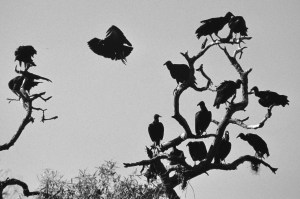 Just a little sinister, aren’t they? From a trip to Argentina a while ago.